How to use this calculator
Estimate soil and column stress sharing and simplified settlement for an equal-strain stone-column unit cell.
- Enter Column area replacement ratio, Column to soil stress concentration ratio, Average unit-cell vertical pressure (kPa), Compressible layer thickness (m), then complete the remaining labeled fields. Match the units shown beside each field and review the result together with the assumptions below.
- Read the worked example below to check the expected input format and result.
- Compare another scenario by changing one input at a time. Use Reset to return to the starting values.
Share unit-cell pressure between a stone column and surrounding soil
This equal-strain unit-cell model takes an entered column-to-soil stress concentration ratio and area replacement ratio, then calculates the corresponding soil stress, column stress, and simplified settlement.
Inputs and units
- Column area replacement ratio: Column plan area divided by total unit-cell plan area, from 0 to 1.
- Column to soil stress concentration ratio: Specified ratio of average column stress to average surrounding-soil stress; this model does not predict the ratio.
- Average unit-cell vertical pressure (kPa): Applied average pressure across the full unit cell.
- Compressible layer thickness (m): Thickness of the soil layer represented by the one-dimensional settlement estimate.
- Soil volume compressibility (1/kPa): Compressibility parameter used for the surrounding soil under the modeled stress change.
Formula and method
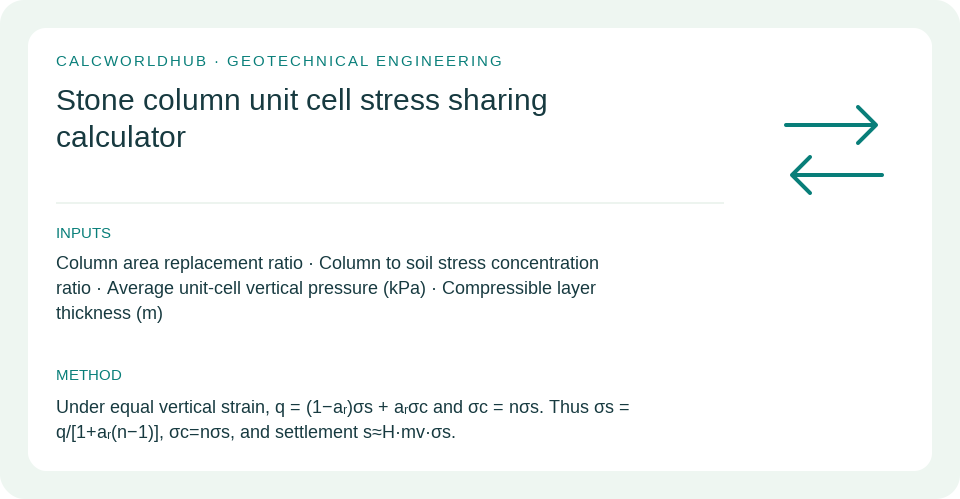
Under equal vertical strain, q = (1−aᵣ)σs + aᵣσc and σc = nσs. Thus σs = q/[1+aᵣ(n−1)], σc=nσs, and settlement s≈H·mv·σs.
Worked example
For aᵣ=0.20, n=4, q=150 kPa, H=6 m, and mv=0.0003 kPa⁻¹, σs=150/[1+0.2×3]=93.75 kPa, σc=375 kPa, and s≈6×0.0003×93.75=0.16875 m.
Interpreting the result
The model assigns more stress to the stiffer column while maintaining the entered average unit-cell pressure. Settlement is a simplified one-dimensional estimate for the entered compressibility and thickness.
Assumptions and limits
The stress concentration ratio is an input assumption, not a result of design. The calculation omits installation effects, nonlinear soil behavior, drainage, group interaction, geometry-specific load transfer, and code checks; it is not a foundation design.
Method references
Frequently asked questions
Does the calculator determine a suitable stress concentration ratio?
No. Enter a value justified by design analysis, testing, or a documented engineering basis. The calculator only applies the specified ratio in an equal-strain balance.
How do I use the Stone column unit cell stress sharing calculator?
Enter Column area replacement ratio, Column to soil stress concentration ratio, Average unit-cell vertical pressure (kPa), Compressible layer thickness (m), then complete the remaining labeled fields. Match the units shown beside each field and review the result together with the assumptions below.
What is a worked example of Stone column unit cell stress sharing?
For aᵣ=0.20, n=4, q=150 kPa, H=6 m, and mv=0.0003 kPa⁻¹, σs=150/[1+0.2×3]=93.75 kPa, σc=375 kPa, and s≈6×0.0003×93.75=0.16875 m.
What does the Stone column unit cell stress sharing calculator calculate?
Estimate soil and column stress sharing and simplified settlement for an equal-strain stone-column unit cell.
What assumptions apply to Stone column unit cell stress sharing?
The stress concentration ratio is an input assumption, not a result of design. The calculation omits installation effects, nonlinear soil behavior, drainage, group interaction, geometry-specific load transfer, and code checks; it is not a foundation design.