How to use this calculator
Calculate titration pH through and around equivalence while retaining water autoionization.
- Enter Acid concentration (mol/L), Acid volume (mL), Base concentration (mol/L), Base volume added (mL), then complete the remaining labeled fields. Match the units shown beside each field and review the result together with the assumptions below.
- Read the worked example below to check the expected input format and result.
- Compare another scenario by changing one input at a time. Use Reset to return to the starting values.
Strong acid strong base titration pH explained
Strong-acid and strong-base neutralization first removes equal amounts of hydrogen and hydroxide ions. The remaining excess is diluted into the combined volume; water autoionization is retained so that the same calculation also works at equivalence and on the base-excess side.
Inputs, symbols, and units
ca— Acid concentration (mol/L)- Molar concentration of the monoprotic strong acid before mixing, in mol/L.
va— Acid volume (mL)- Acid solution volume in mL; both solution volumes use the same unit.
cb— Base concentration (mol/L)- Molar concentration of the monovalent strong base before mixing, in mol/L.
vb— Base volume added (mL)- Base solution volume in mL; total volume is the sum of the two entered volumes.
kw— Water ionic product (mol²/L²)- Positive water ion-product concentration constant for the modeled temperature; 1e−14 is the usual idealized 25 °C value.
Formula and method
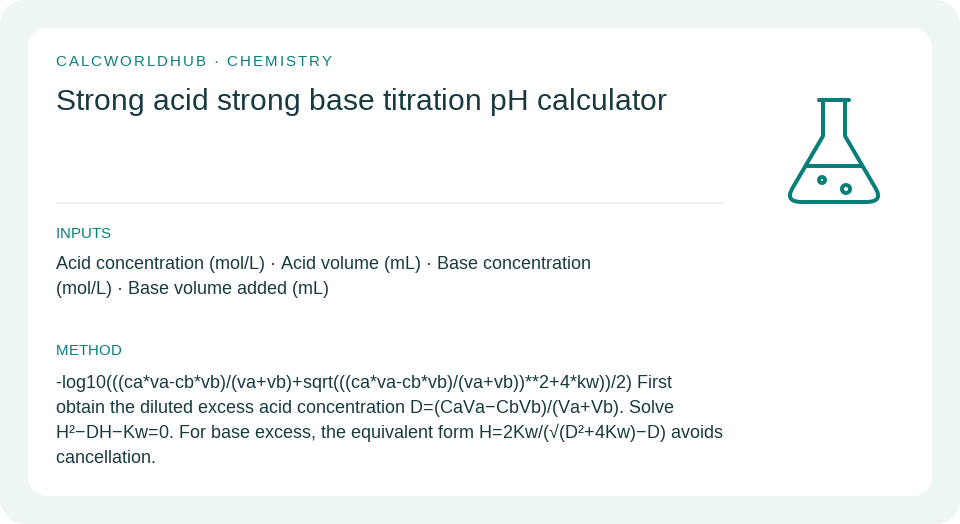
-log10(((ca*va-cb*vb)/(va+vb)+sqrt(((ca*va-cb*vb)/(va+vb))**2+4*kw))/2)
First obtain the diluted excess acid concentration D=(CaVa−CbVb)/(Va+Vb). Solve H²−DH−Kw=0. For base excess, the equivalent form H=2Kw/(√(D²+4Kw)−D) avoids cancellation.
A worked scenario
Acid concentration (mol/L) = 0.1; Acid volume (mL) = 25; Base concentration (mol/L) = 0.1; Base volume added (mL) = 20; Water ionic product (mol²/L²) = 1.00000000e-14.
- Mixture pH: 1.95424251 pH
The acid contributes 2.5 mmol and base 2.0 mmol. Their 0.5 mmol difference is diluted into 45 mL before the water-equilibrium correction is applied.
Assumptions and edge cases
Monoprotic fully dissociated acid and monovalent strong base; activities and mixing heat are excluded.
Frequently asked questions
Does equivalence always mean pH 7?
Only when the entered water product implies that neutral pH.
Why retain water near equivalence?
Excess-ion subtraction alone becomes inaccurate.
Are weak acids supported?
Use the weak-acid titration solver.
How do I use the Strong acid strong base titration pH calculator?
Enter Acid concentration (mol/L), Acid volume (mL), Base concentration (mol/L), Base volume added (mL), then complete the remaining labeled fields. Match the units shown beside each field and review the result together with the assumptions below.
What is a worked example of Strong acid strong base titration pH?
Acid concentration (mol/L) = 0.1; Acid volume (mL) = 25; Base concentration (mol/L) = 0.1; Base volume added (mL) = 20; Water ionic product (mol²/L²) = 1.00000000e-14. Mixture pH: 1.95424251 pH The acid contributes 2.5 mmol and base 2.0 mmol. Their 0.5 mmol difference is diluted into 45 mL before the water-equilibrium correction is applied.
Read our calculation methodology.