How to use this calculator
Estimate the pH shift when a measured amount of strong acid or base is added to a conjugate buffer.
- Enter Initial conjugate acid amount (mmol), Initial conjugate base amount (mmol), pKa of the conjugate acid, Strong acid added (mmol H+ equivalents), then complete the remaining labeled fields. Match the units shown beside each field and review the result together with the assumptions below.
- Read the worked example below to check the expected input format and result.
- Compare another scenario by changing one input at a time. Use Reset to return to the starting values.
How this calculation works
When strong titrant is added to a buffer, it first reacts stoichiometrically with one member of the conjugate pair. This calculator updates the acid and base mole amounts, then uses their final ratio to estimate pH while both forms remain present.
Inputs and units
initialAcid— Initial conjugate acid amount (mmol)- Enter moles of the protonated buffer form before adding titrant.
initialBase— Initial conjugate base amount (mmol)- Enter moles of the deprotonated buffer form before adding titrant.
pKa— pKa of the conjugate acid- Use the pKa for the relevant acid, temperature, and solution conditions.
strongAcidAdded— Strong acid added (mmol H+ equivalents)- Enter the acid equivalents added; leave at 0 when adding strong base.
strongBaseAdded— Strong base added (mmol OH− equivalents)- Enter the base equivalents added; leave at 0 when adding strong acid.
Formula
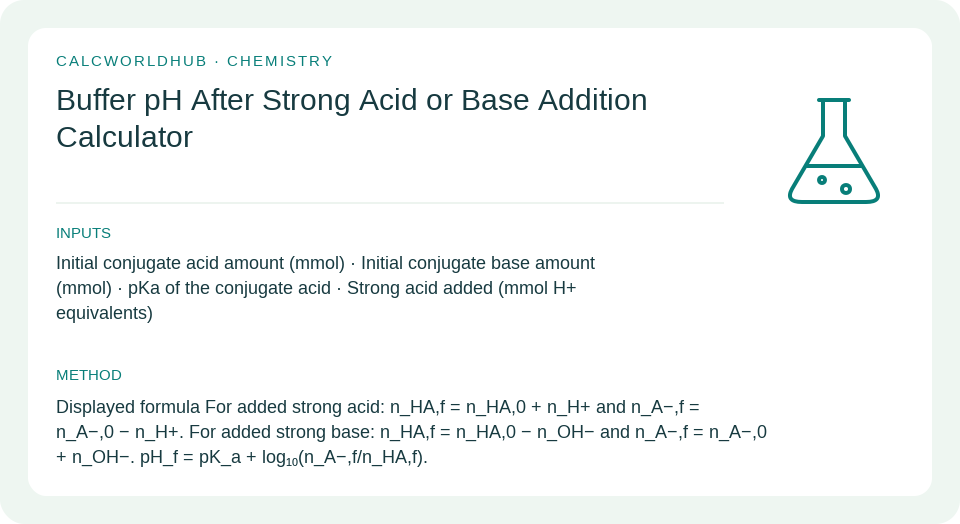
For added strong acid: n_HA,f = n_HA,0 + n_H+ and n_A−,f = n_A−,0 − n_H+. For added strong base: n_HA,f = n_HA,0 − n_OH− and n_A−,f = n_A−,0 + n_OH−. pH_f = pK_a + log₁₀(n_A−,f/n_HA,f).
Method
Enter initial conjugate acid and base amounts in mmol, plus the strong acid or strong base added in mmol. Exactly one titrant amount may be positive. The common final solution volume cancels from the concentration ratio when both buffer species share that volume.
Worked example
An ammonia buffer starts with 25 mmol NH₄⁺ and 40 mmol NH₃ at pKa 9.25. Adding 15 mmol OH⁻ leaves 10 mmol acid form and 55 mmol base form, so pH ≈ 9.25 + log₁₀(55/10) = 9.990.
Assumptions and limits
This Henderson–Hasselbalch estimate assumes one monoprotic conjugate pair, complete stoichiometric neutralization, and both forms remaining after titration. It does not model activity coefficients, additional equilibria, electrode calibration, temperature effects, or a buffer exhausted by excess titrant. It is for chemistry learning and planning, not clinical use.
Frequently asked questions
Why do I enter millimoles instead of concentrations?
For a shared final volume, the Henderson–Hasselbalch concentration ratio equals the ratio of the conjugate-pair mole amounts.
What happens if the added titrant consumes all of one form?
The calculator reports that the buffer-ratio model no longer applies; after exhaustion, excess strong acid or base controls the chemistry.
Does added water change this pH estimate?
Ideal dilution changes both buffer concentrations by the same factor, so their ratio stays the same; real activity and volume effects are outside this model.
How do I use the Buffer pH After Strong Acid or Base Addition Calculator?
Enter Initial conjugate acid amount (mmol), Initial conjugate base amount (mmol), pKa of the conjugate acid, Strong acid added (mmol H+ equivalents), then complete the remaining labeled fields. Match the units shown beside each field and review the result together with the assumptions below.
What is a worked example of Buffer pH After Strong Acid or Base Addition?
An ammonia buffer starts with 25 mmol NH₄⁺ and 40 mmol NH₃ at pKa 9.25. Adding 15 mmol OH⁻ leaves 10 mmol acid form and 55 mmol base form, so pH ≈ 9.25 + log₁₀(55/10) = 9.990.
Reference: Purdue University General Chemistry guide to buffer pH after strong acid or base addition. See our calculation methodology.