How to use this calculator
Compare an oscillation timescale with convective flow using frequency, characteristic length, and flow speed.
- Enter Oscillation frequency f (Hz), Characteristic length L (m), Reference flow speed U (m/s). Match the units shown beside each field and review the result together with the assumptions below.
- Read the worked example below to check the expected input format and result.
- Compare another scenario by changing one input at a time. Use Reset to return to the starting values.
How this calculation works
The Strouhal number compares local unsteady acceleration with convective acceleration in a flow. It is commonly written as frequency times characteristic length divided by reference speed. For vortex shedding, the frequency is the shedding frequency and the length is usually a body dimension such as cylinder diameter. Enter frequency in cycles per second (Hz), not angular frequency in radians per second.
Inputs and units
frequency— Oscillation frequency f (Hz)- Cycles per second, such as a measured vortex-shedding frequency.
length— Characteristic length L (m)- Relevant body or flow length scale, such as cylinder diameter.
velocity— Reference flow speed U (m/s)- Representative mean speed of the approaching or surrounding flow.
Formula
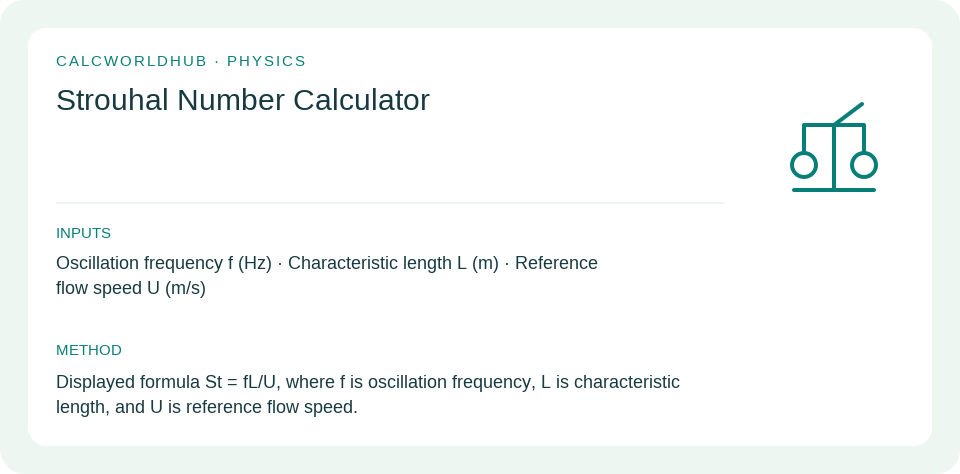
St = fL/U, where f is oscillation frequency, L is characteristic length, and U is reference flow speed.
Method
Multiply the oscillation frequency by its characteristic length, then divide by reference speed. In the equivalent time-scale form, St = L/(TU), with T = 1/f.
Worked example
For a 10 Hz oscillation, characteristic length 0.050 m, and flow speed 2.0 m/s, St = 0.2500.
Assumptions and limits
The length, frequency, and velocity must describe the same flow phenomenon and reference condition. For angular frequency ω, convert to cycles per second with f = ω/(2π) before using this form. A zero frequency gives St = 0; zero flow speed is undefined.
Frequently asked questions
What does a Strouhal number describe?
It measures the relative importance of unsteady or oscillatory effects compared with convection in a flow.
Should I enter frequency in hertz or radians per second?
Enter hertz. If the known value is angular frequency ω in radians per second, divide it by 2π first.
Which length is used for vortex shedding?
A common choice is the characteristic body dimension across the flow, such as a cylinder diameter, but use the length specified by the model or experiment.
How do I use the Strouhal Number Calculator?
Enter Oscillation frequency f (Hz), Characteristic length L (m), Reference flow speed U (m/s). Match the units shown beside each field and review the result together with the assumptions below.
What is a worked example of Strouhal Number?
For a 10 Hz oscillation, characteristic length 0.050 m, and flow speed 2.0 m/s, St = 0.2500.
Reference: technical reference. See our calculation methodology.