How to use this calculator
Classify open-channel flow as subcritical, near-critical, or supercritical from discharge, flow area, and top width.
- Enter Discharge Q (m³/s), Flow area A (m²), Water-surface top width T (m), Gravitational acceleration g (m/s²). Match the units shown beside each field and review the result together with the assumptions below.
- Read the worked example below to check the expected input format and result.
- Compare another scenario by changing one input at a time. Use Reset to return to the starting values.
How this calculation works
The Froude number compares mean flow speed with a gravity-wave speed based on hydraulic depth. In an open channel, hydraulic depth is flow area divided by the free-surface top width, so the result describes the flow regime for the entered section and discharge.
Inputs and units
flow— Discharge Q (m³/s)- Volume flow rate through the selected cross section.
area— Flow area A (m²)- Wetted cross-sectional area carrying the entered discharge.
topWidth— Water-surface top width T (m)- Width of the free surface at the entered flow depth.
gravity— Gravitational acceleration g (m/s²)- Use local gravitational acceleration if a nonstandard value is required.
Formula
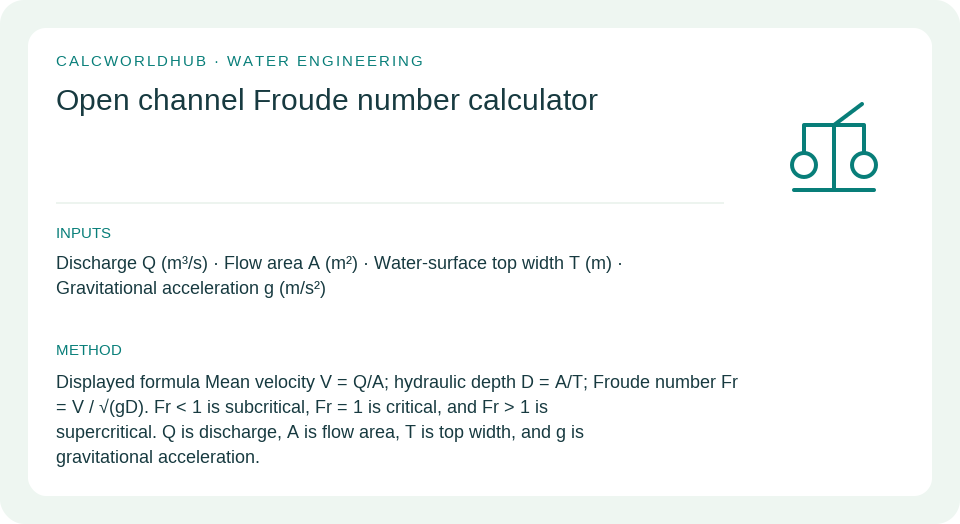
Mean velocity V = Q/A; hydraulic depth D = A/T; Froude number Fr = V / √(gD). Fr < 1 is subcritical, Fr = 1 is critical, and Fr > 1 is supercritical. Q is discharge, A is flow area, T is top width, and g is gravitational acceleration.
Method
The calculator derives mean velocity from continuity and hydraulic depth from section geometry, then evaluates the standard open-channel Froude ratio. A small numeric tolerance is used only to label a result effectively equal to one as near-critical.
Worked example
For Q = 3.0 m³/s, A = 1.5 m², T = 1.2 m, and g = 9.80665 m/s², mean velocity is 2.0 m/s, hydraulic depth is 1.25 m, and Fr ≈ 0.5712, which is subcritical.
Assumptions and limits
Assumes a representative mean velocity and a single connected free-surface section. Strongly nonuniform velocity, overbank flow, rapidly varied flow, secondary currents, air entrainment, or complex cross sections can require a more detailed hydraulic model. The regime label is descriptive, not a design approval.
Frequently asked questions
What is hydraulic depth?
It is the flow area divided by the water-surface top width, A/T; it is not always the same as the physical depth at every point in an irregular section.
What does a Froude number below one indicate?
Under the open-channel model, subcritical flow is slower than the gravity-wave speed represented by hydraulic depth.
How is this different from critical depth?
This calculator evaluates the regime at a known section and flow state. A critical-depth calculation instead solves for the depth at which Fr equals one for a specified geometry and discharge.
Can this label replace a hydraulic model?
No. It is a section-based screening calculation and does not model transitions, energy losses, or nonuniform flow fields.
How do I use the Open channel Froude number calculator?
Enter Discharge Q (m³/s), Flow area A (m²), Water-surface top width T (m), Gravitational acceleration g (m/s²). Match the units shown beside each field and review the result together with the assumptions below.
Reference: USACE HEC-RAS training notes on Froude number and flow regime. See our calculation methodology.