How to use this calculator
Estimate geometric drop along one leveling sight and apply an explicit refraction fraction for a planning comparison.
- Enter Single sight length (m), Earth radius (km), Refraction fraction k. Match the units shown beside each field and review the result together with the assumptions below.
- Read the worked example below to check the expected input format and result.
- Compare another scenario by changing one input at a time. Use Reset to return to the starting values.
How this calculation works
A straight tangent sight line and the curved Earth surface separate with distance. This small-angle model estimates that geometric separation and then applies a user-entered fraction to represent a simplified refraction scenario. It is a single-sight geometry check, not the full correction for a level section or height difference.
Inputs and units
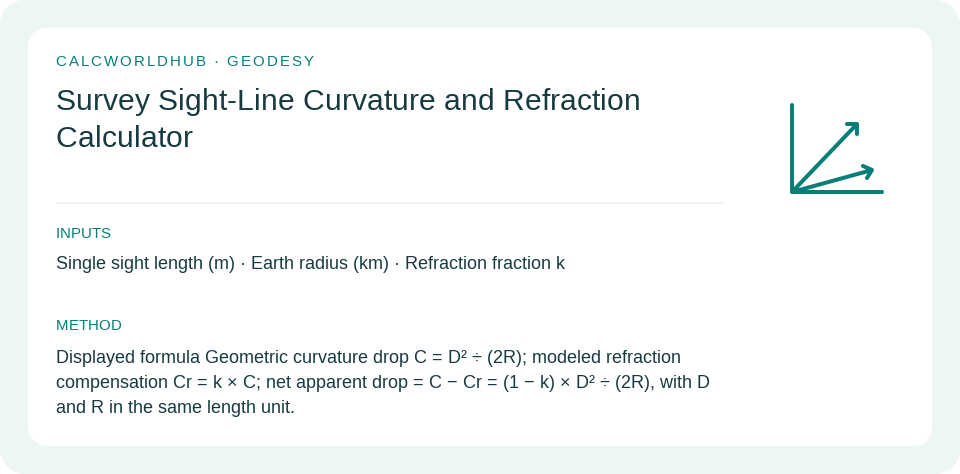
sightDistance— Single sight length (m)- Horizontal instrument-to-staff sight distance in meters.
earthRadiusKm— Earth radius (km)- Use a representative radius for a simple spherical-Earth approximation.
refractionFraction— Refraction fraction k- Scenario fraction of the curvature term offset by refraction; enter an explicit value from 0 to less than 1.
Formula
Geometric curvature drop C = D² ÷ (2R); modeled refraction compensation Cr = k × C; net apparent drop = C − Cr = (1 − k) × D² ÷ (2R), with D and R in the same length unit.
Method
The earth-radius input is converted from kilometers to meters before calculating. The refraction factor k is an explicit scenario input, so the page does not assume one universal atmosphere. A positive net drop describes the magnitude below a tangent line; applying a signed correction to survey observations depends on the observation convention and method.
Worked example
For a 1,000 m sight, a 6,371 km Earth radius, and a scenario factor k = 0.13, the geometric drop is 1,000² ÷ (2 × 6,371,000) = 0.07848 m. The modeled compensation is 0.01020 m, leaving about 0.06828 m (68.28 mm) net apparent drop.
Assumptions and limits
This is a first-order geometric illustration. Precise leveling refraction depends on observed or modeled temperature gradients, sight lengths, setup geometry, and procedure; the NOAA reference describes a different data-dependent method. Do not use the default factor as an official correction or substitute for balanced sights and survey specifications.
Frequently asked questions
Is 0.13 a universal refraction coefficient?
No. It is only the displayed scenario default for this simplified model. Atmospheric conditions and precise-leveling procedures require different, data-based treatment.
Does the output directly correct a measured elevation difference?
No. It reports single-sight geometric magnitudes. A signed correction for a level section depends on sight balance, reading convention, and the specified survey method.
Why enter Earth radius?
It makes the spherical approximation explicit and lets users test a representative local or model radius rather than hide that assumption.
How do I use the Survey Sight-Line Curvature and Refraction Calculator?
Enter Single sight length (m), Earth radius (km), Refraction fraction k. Match the units shown beside each field and review the result together with the assumptions below.
What is a worked example of Survey Sight-Line Curvature and Refraction?
For a 1,000 m sight, a 6,371 km Earth radius, and a scenario factor k = 0.13, the geometric drop is 1,000² ÷ (2 × 6,371,000) = 0.07848 m. The modeled compensation is 0.01020 m, leaving about 0.06828 m (68.28 mm) net apparent drop.
Reference: NOAA National Geodetic Survey memorandum on data-dependent precise-leveling refraction corrections. See our calculation methodology.