Survivors after log reduction calculator
Estimate remaining microbes after a stated base-10 log reduction. Enter your values below to see the result and method.
inputs.
Related calculators
These tools cover nearby questions while keeping this page focused on its own calculation.
How to use this calculator
Free Survivors after log reduction calculator. Estimate remaining microbes after a stated base-10 log reduction. Formula, example, and assumptions explained.
- Enter Initial count (CFU), Log₁₀ reduction. Match the units shown beside each field and review the result together with the assumptions below.
- Read the worked example below to check the expected input format and result.
- Compare another scenario by changing one input at a time. Use Reset to return to the starting values.
Choose the population model and time window
Use this page to answer a population or culture question under a stated model. Estimate remaining microbes after a stated base-10 log reduction.
Inputs and units
Use the units printed beside each field. These values are Initial count (CFU), Log₁₀ reduction.
- Initial count (CFU): Starting count of colony-forming units before the stated reduction.
- Log₁₀ reduction: Base-10 decrease in count; each unit represents a tenfold reduction in the idealized surviving count.
Population equation and checked example
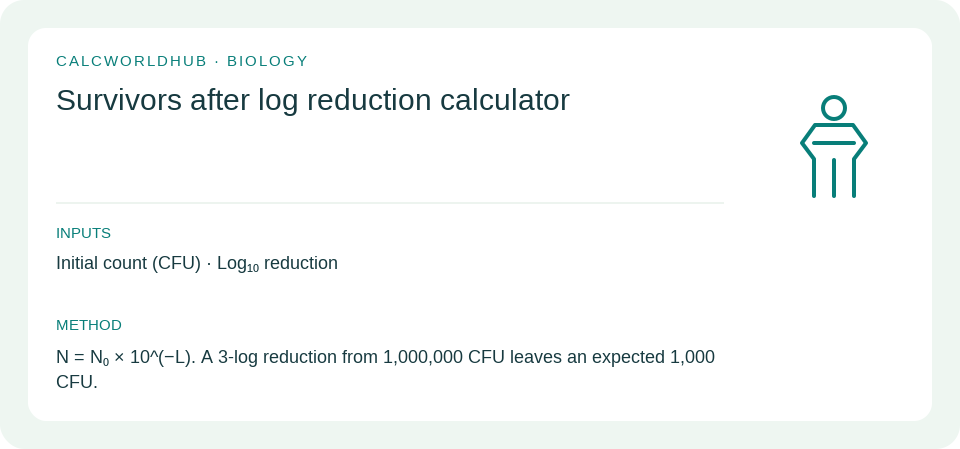
N = N₀ × 10^(−L).
A 3-log reduction from 1,000,000 CFU leaves an expected 1,000 CFU.
Reading a population estimate
A population model is only as useful as its boundary conditions. Compare its assumptions with the sampling interval and whether the culture is closed, resource-limited, or exposed to a treatment.
Assumptions and limitations
This is a deterministic expected count from a log-reduction value; actual survivor counts vary and can be discrete.
Method reference: U.S. FDA, Juice HACCP Regulator Training: log reductions.
Frequently asked questions
What should I enter for the survivors after log reduction?
Enter Initial count (CFU), Log₁₀ reduction. Use the units shown beside each field and values from the same sample or model.
Which assumptions matter for this survivors after log reduction?
This is a deterministic expected count from a log-reduction value; actual survivor counts vary and can be discrete.
When should I model population growth rather than a treatment reduction?
A population projection models growth across generations. This page applies a stated log₁₀ reduction to an initial count and does not establish treatment efficacy.
How do I use the Survivors after log reduction calculator?
Enter Initial count (CFU), Log₁₀ reduction. Match the units shown beside each field and review the result together with the assumptions below.
What is a worked example of Survivors after log reduction?
N = N₀ × 10^(−L). A 3-log reduction from 1,000,000 CFU leaves an expected 1,000 CFU.
Read the calculation methodology and privacy policy.