How to use this calculator
Compare a tax-exempt bond yield with the taxable yield needed to match it after income tax.
- Enter Tax-exempt yield (%), Marginal tax rate (%). Match the units shown beside each field and review the result together with the assumptions below.
- Read the worked example below to check the expected input format and result.
- Compare another scenario by changing one input at a time. Use Reset to return to the starting values.
How this calculation works
Tax-equivalent yield estimates the taxable investment yield that would leave the same after-tax return as a tax-exempt yield under one selected marginal tax rate. It is a comparison aid; the applicable tax treatment depends on the investor and jurisdiction.
Inputs and units
exemptYield— Tax-exempt yield (%)- Yield quoted for the tax-exempt investment.
taxRate— Marginal tax rate (%)- Tax rate used for the comparison, from 0% up to but not including 100%.
Formula
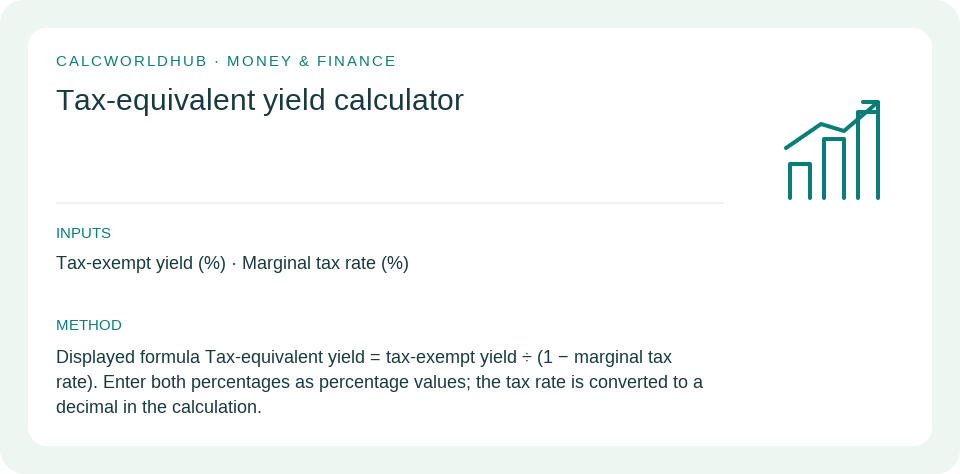
Tax-equivalent yield = tax-exempt yield ÷ (1 − marginal tax rate). Enter both percentages as percentage values; the tax rate is converted to a decimal in the calculation.
Worked example
A 3.6% tax-exempt yield compared at a 24% marginal rate has a tax-equivalent yield of 3.6 ÷ (1 − 0.24) = 4.7368%.
Assumptions and limits
Excludes state, local, alternative-minimum, phaseout, and account-specific tax rules. It does not determine tax eligibility or recommend a security; use a tax professional for individual treatment.
Frequently asked questions
What does tax-equivalent yield mean?
It is the taxable yield that would match the selected tax-exempt yield after applying the entered marginal rate under this simplified comparison.
Does the result include state or local taxes?
No. Enter one effective marginal rate that fits your comparison, and account separately for other taxes or exemptions.
Does this say which bond to buy?
No. It compares yields only and omits credit risk, liquidity, fees, and tax-specific circumstances.
How do I use the Tax-equivalent yield calculator?
Enter Tax-exempt yield (%), Marginal tax rate (%). Match the units shown beside each field and review the result together with the assumptions below.
What is a worked example of Tax-equivalent yield?
A 3.6% tax-exempt yield compared at a 24% marginal rate has a tax-equivalent yield of 3.6 ÷ (1 − 0.24) = 4.7368%.
Read our calculation methodology.