How to use this calculator
Estimate the data in flight needed to fill a path from its throughput and round-trip time.
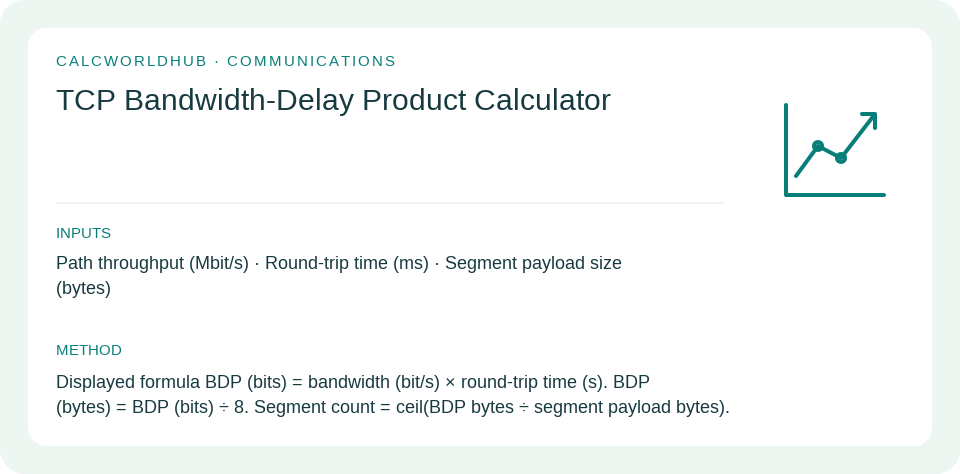
- Enter Path throughput (Mbit/s), Round-trip time (ms), Segment payload size (bytes). Match the units shown beside each field and review the result together with the assumptions below.
- Read the worked example below to check the expected input format and result.
- Compare another scenario by changing one input at a time. Use Reset to return to the starting values.
How this calculation works
A high-capacity path can sit partly idle if too little data is outstanding while acknowledgments return. The bandwidth-delay product (BDP) estimates how much data corresponds to one round trip at the entered rate; dividing by a segment payload gives a rough segment count.
Inputs and units
bandwidthMbps— Path throughput (Mbit/s)- Use an estimated or measured end-to-end throughput in decimal Mbit/s.
roundTripTimeMs— Round-trip time (ms)- Enter end-to-end RTT, not one-way propagation delay.
segmentPayloadBytes— Segment payload size (bytes)- Enter the payload bytes per segment for the rough segment-count estimate.
Formula
BDP (bits) = bandwidth (bit/s) × round-trip time (s). BDP (bytes) = BDP (bits) ÷ 8. Segment count = ceil(BDP bytes ÷ segment payload bytes).
Method
The calculator uses decimal megabits per second and seconds for round-trip time. The segment estimate rounds upward so the requested payload capacity is not underfilled by a fractional segment.
Worked example
At 100 Mbit/s and 40 ms RTT, BDP is 100,000,000 × 0.040 = 4,000,000 bits, or 500,000 bytes (500 kB). With 1,460 payload bytes per segment, ceil(500,000 ÷ 1,460) = 343 segments.
Assumptions and limits
This is a path-capacity estimate, not a TCP throughput prediction or a prescribed socket setting. Protocol overhead, congestion control, receiver and sender window limits, loss, queuing, and application behavior affect real transfers.
Frequently asked questions
What does the bandwidth-delay product represent?
It is the amount of data that would be transmitted during one round trip at the entered throughput.
Is this the same as a TCP window recommendation?
No. It gives a path-filling data estimate; TCP windows and throughput also depend on protocol and endpoint constraints.
Why is the segment count rounded up?
A fractional segment cannot carry the remaining bytes, so the estimate uses the next whole payload segment.
Should I use advertised line speed or measured throughput?
For a planning estimate, use the throughput that the end-to-end path can actually sustain, when known.
How do I use the TCP Bandwidth-Delay Product Calculator?
Enter Path throughput (Mbit/s), Round-trip time (ms), Segment payload size (bytes). Match the units shown beside each field and review the result together with the assumptions below.
Reference: IETF RFC 7323 discussion of TCP performance on high bandwidth-delay-product paths. See our calculation methodology.