How to use this calculator
Find a telescope’s f-number from focal length and clear aperture, or solve its dimensions for a target ratio.
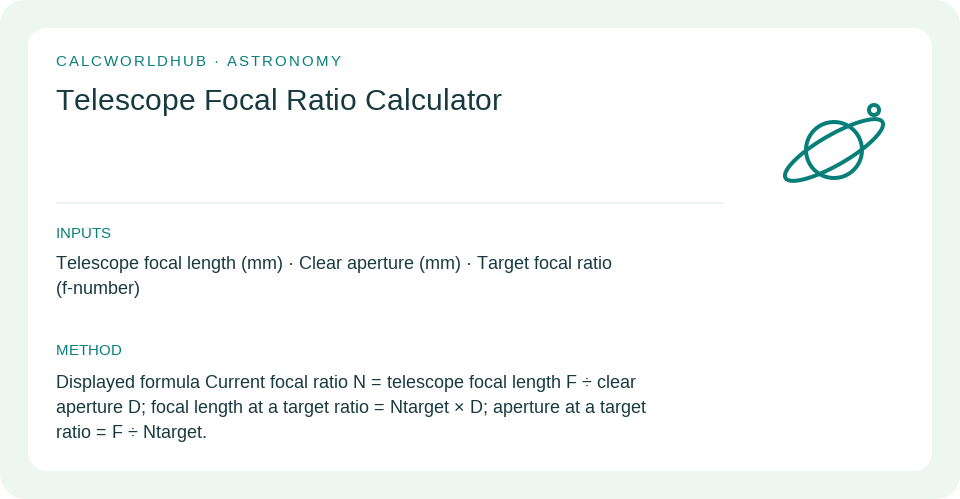
- Enter Telescope focal length (mm), Clear aperture (mm), Target focal ratio (f-number). Match the units shown beside each field and review the result together with the assumptions below.
- Read the worked example below to check the expected input format and result.
- Compare another scenario by changing one input at a time. Use Reset to return to the starting values.
How this calculation works
A telescope’s focal ratio compares its focal length with its clear aperture. This page handles the geometry and lets an observer compare a desired ratio by solving for the focal length at a fixed aperture or the aperture at a fixed focal length. The measurements must use the same unit.
Inputs and units
focalLength— Telescope focal length (mm)- Use the telescope’s effective focal length in millimeters.
clearAperture— Clear aperture (mm)- Enter the unobstructed entrance aperture in the same unit.
targetRatio— Target focal ratio (f-number)- Choose a comparison f-number for the two design outputs.
Formula
Current focal ratio N = telescope focal length F ÷ clear aperture D; focal length at a target ratio = Ntarget × D; aperture at a target ratio = F ÷ Ntarget.
Method
The focal ratio is dimensionless and is conventionally written as f/N. The two design outputs answer separate what-if questions: the first keeps the entered aperture fixed, and the second keeps the entered focal length fixed.
Worked example
A 900 mm focal length divided by a 150 mm clear aperture gives f/6. With a target of f/5.5, the same 150 mm aperture would need a 825 mm focal length; at 900 mm focal length, the matching aperture would be about 163.64 mm.
Assumptions and limits
Use the clear optical aperture, not the tube diameter. This calculation does not account for central obstruction, transmission, eyepiece, detector, seeing, or image quality, and focal ratio by itself does not determine visual brightness or light-gathering area.
Frequently asked questions
Does f/6 mean six times the aperture?
Yes, for the entered setup the focal length is six times its clear aperture; the f-number is their ratio.
Should I enter mirror diameter or tube diameter?
Use the clear optical aperture specified for the telescope. A surrounding tube is not the aperture.
Does a smaller focal ratio automatically make a visual target brighter?
No. Visual light-gathering depends principally on aperture and optical losses; focal ratio alone does not set the object’s apparent brightness.
How do I use the Telescope Focal Ratio Calculator?
Enter Telescope focal length (mm), Clear aperture (mm), Target focal ratio (f-number). Match the units shown beside each field and review the result together with the assumptions below.
What is a worked example of Telescope Focal Ratio?
A 900 mm focal length divided by a 150 mm clear aperture gives f/6. With a target of f/5.5, the same 150 mm aperture would need a 825 mm focal length; at 900 mm focal length, the matching aperture would be about 163.64 mm.
Reference: Sky & Telescope telescope-owner formulas for focal ratio and related optical quantities. See our calculation methodology.