How to use this calculator
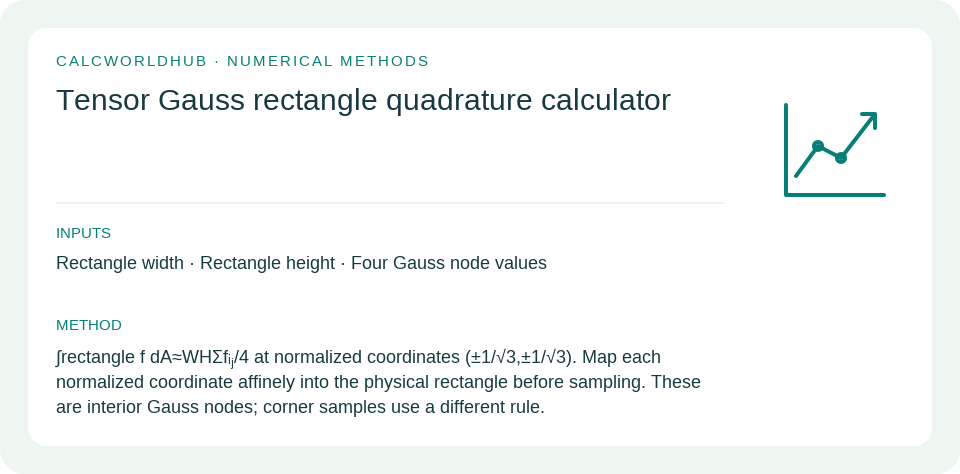
Estimate an area integral on a rectangle from the four nodes of a two-by-two Gauss–Legendre tensor rule.
- Enter Rectangle width, Rectangle height, Four Gauss node values. Match the units shown beside each field and review the result together with the assumptions below.
- Read the worked example below to check the expected input format and result.
- Compare another scenario by changing one input at a time. Use Reset to return to the starting values.
Tensor Gauss rectangle quadrature explained
A numerical walkthrough
Rectangle width = 2; Rectangle height = 3; Four Gauss node values = [1, 2, 3, 4].
- Rectangle integral estimate: 15 integrand × area
- Quadrature mean value: 2.5 integrand units
- Sample range: 3 integrand units
A two-by-three rectangle with Gauss values 1,2,3,4 yields integral 15 and quadrature mean 2.5.
The model behind the numbers
∫rectangle f dA≈WHΣfᵢⱼ/4 at normalized coordinates (±1/√3,±1/√3).
Map each normalized coordinate affinely into the physical rectangle before sampling. These are interior Gauss nodes; corner samples use a different rule.
What to enter
width— Rectangle width- Positive x extent.
height— Rectangle height- Positive y extent.
samples— Four Gauss node values- Values at all combinations of normalized x,y=plus or minus 1/sqrt(3). Use comma-separated values in the stated order.
Interpreting the result
Axis-aligned or affinely parameterized rectangles with a constant Jacobian only. The rule is exact through cubic degree in each separate coordinate, not for arbitrary functions.
Reading the outputs
Integral combines area with integrand units. Mean and sample range remain on the integrand scale.
Frequently asked questions
Can I use corner values?
No. They are not the Gauss node locations required by this formula.
Is sample range an error estimate?
No. It only summarizes variation among four samples.
Do I need the rectangle center?
Only to locate the nodes when sampling; width and height suffice for the final weighted sum.
How do I use the Tensor Gauss rectangle quadrature calculator?
Enter Rectangle width, Rectangle height, Four Gauss node values. Match the units shown beside each field and review the result together with the assumptions below.
What is a worked example of Tensor Gauss rectangle quadrature?
Rectangle width = 2; Rectangle height = 3; Four Gauss node values = [1, 2, 3, 4]. Rectangle integral estimate: 15 integrand × area Quadrature mean value: 2.5 integrand units Sample range: 3 integrand units A two-by-three rectangle with Gauss values 1,2,3,4 yields integral 15 and quadrature mean 2.5.
Background or definition reference: NIST DLMF quadrature.
Read our calculation methodology.