How to use this calculator
Estimate the ideal arithmetic-average roughness left by a turning feed rate and tool nose radius.
- Enter Feed per revolution (mm/rev), Tool nose radius (mm). Match the units shown beside each field and review the result together with the assumptions below.
- Read the worked example below to check the expected input format and result.
- Compare another scenario by changing one input at a time. Use Reset to return to the starting values.
How this calculation works
In a simple turning model, the tool nose leaves repeating feed marks on the workpiece. Feed per revolution and nose radius determine the ideal geometric roughness before material behavior, vibration, wear, and built-up edge affect the measured finish.
Inputs and units
feed— Feed per revolution (mm/rev)- Turning feed rate divided by spindle speed.
radius— Tool nose radius (mm)- Positive insert nose radius.
Formula
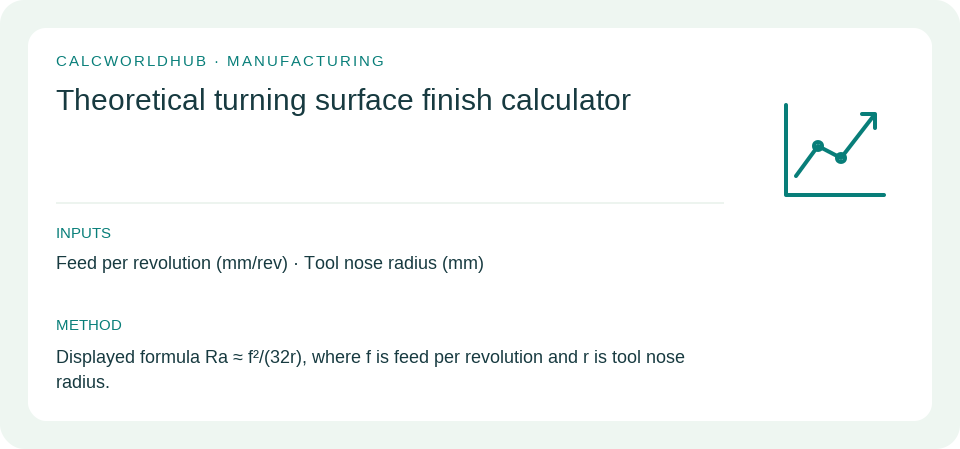
Ra ≈ f²/(32r), where f is feed per revolution and r is tool nose radius.
Method
The estimate uses the idealized arithmetic-average profile roughness for a rounded tool nose when feed is small relative to nose radius. Divide the squared feed per revolution by 32 times the radius, then convert millimeters to micrometers.
Worked example
At 0.20 mm/rev feed and a 0.80 mm nose radius, Ra ≈ 0.20²/(32×0.80) mm = 0.0015625 mm = 1.563 µm.
Assumptions and limits
This geometric estimate is not a surface-finish guarantee. It omits tool wear, edge radius, material tearing, machine vibration, runout, coolant, and measurement-filter settings. Compare the estimate with an actual profilometer measurement and the drawing standard.
Frequently asked questions
Is this the measured Ra?
No. It is a geometric estimate; vibration, material, tool wear, and metrology can change the measured value.
Does a larger nose radius always improve finish?
The ideal formula predicts lower roughness at fixed feed, but larger nose radii can change forces and stability.
Can I enter feed in inches per revolution?
Convert feed and nose radius to the same length unit before entering them; the result is converted to micrometers.
How do I use the Theoretical turning surface finish calculator?
Enter Feed per revolution (mm/rev), Tool nose radius (mm). Match the units shown beside each field and review the result together with the assumptions below.
What is a worked example of Theoretical turning surface finish?
At 0.20 mm/rev feed and a 0.80 mm nose radius, Ra ≈ 0.20²/(32×0.80) mm = 0.0015625 mm = 1.563 µm.
Reference: Peer-reviewed theoretical turning surface-roughness model. See our calculation methodology.