How to use this calculator
Calculate a material’s thermal effusivity from conductivity, density, and specific heat for transient contact-heat comparisons.
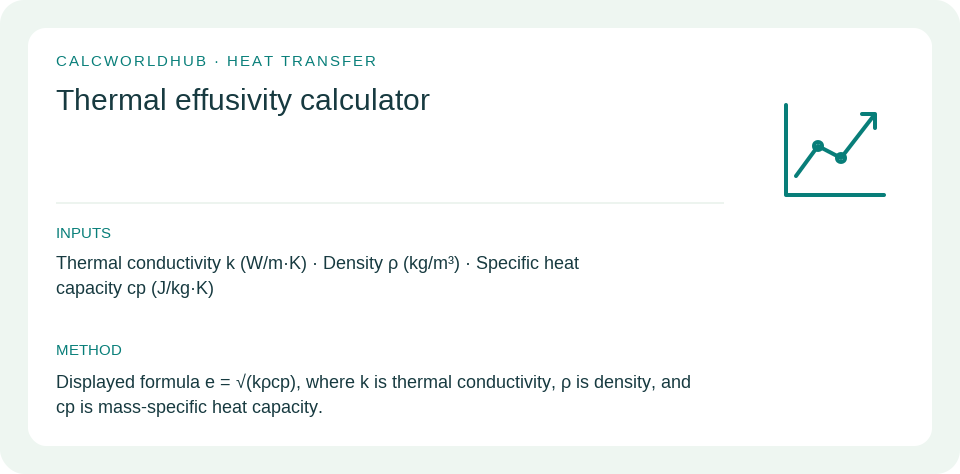
- Enter Thermal conductivity k (W/m·K), Density ρ (kg/m³), Specific heat capacity cp (J/kg·K). Match the units shown beside each field and review the result together with the assumptions below.
- Read the worked example below to check the expected input format and result.
- Compare another scenario by changing one input at a time. Use Reset to return to the starting values.
How this calculation works
Thermal effusivity combines the ability to conduct heat with the heat capacity available per unit volume. In ideal transient contact between materials, it helps explain how strongly each side exchanges heat at the interface; it is different from conductivity alone and from thermal diffusivity.
Inputs and units
k— Thermal conductivity k (W/m·K)- Material conductivity in SI units.
rho— Density ρ (kg/m³)- Bulk material density.
cp— Specific heat capacity cp (J/kg·K)- Mass-specific heat capacity at the relevant temperature.
Formula
e = √(kρcp), where k is thermal conductivity, ρ is density, and cp is mass-specific heat capacity.
Method
Multiply conductivity by volumetric heat capacity (density times specific heat), then take the square root. With SI inputs, the result is in J/(m²·K·√s).
Worked example
For k = 0.60 W/(m·K), ρ = 1,000 kg/m³, and cp = 4,180 J/(kg·K), e = √(0.60×1,000×4,180) ≈ 1,583.7 J/(m²·K·√s).
Assumptions and limits
Uses constant isotropic properties at the temperature of interest. Effusivity is a material property used in ideal contact and transient-heat models; it does not by itself determine interface temperature or heat flow without contact conditions, initial temperatures, and geometry.
Frequently asked questions
What does high effusivity indicate?
A material with higher effusivity can exchange more heat with a contacting material during the early transient, under comparable ideal contact conditions.
How is effusivity different from diffusivity?
Effusivity is √(kρcp) and relates to contact heat exchange; diffusivity is k/(ρcp) and describes the rate at which temperature variations spread within a material.
Does it predict how warm a surface will feel?
Not by itself. Contact temperature also depends on the other material, starting temperatures, contact resistance, and duration.
How do I use the Thermal effusivity calculator?
Enter Thermal conductivity k (W/m·K), Density ρ (kg/m³), Specific heat capacity cp (J/kg·K). Match the units shown beside each field and review the result together with the assumptions below.
What is a worked example of Thermal effusivity?
For k = 0.60 W/(m·K), ρ = 1,000 kg/m³, and cp = 4,180 J/(kg·K), e = √(0.60×1,000×4,180) ≈ 1,583.7 J/(m²·K·√s).
Reference: Peer-reviewed research defining thermal effusivity as √(kρcp). See our calculation methodology.