How to use this calculator
Resolve reflected thermal radiation among three surfaces when one pairwise Stefan–Boltzmann calculation cannot represent the enclosure.
- Enter Surface areas in surface order (m²), Absolute surface temperatures (K), Total gray emissivities, View factors as three row-major rows. Match the units shown beside each field and review the result together with the assumptions below.
- Read the worked example below to check the expected input format and result.
- Compare another scenario by changing one input at a time. Use Reset to return to the starting values.
Three surface diffuse gray enclosure radiosity explained
A numerical walkthrough
Surface areas in surface order (m²) = [1, 1, 2]; Absolute surface temperatures (K) = [700, 400, 300]; Total gray emissivities = [0.8, 0.6, 0.9]; View factors as three row-major rows = [0, 0.2, 0.8, 0.2, 0, 0.8, 0.4, 0.4, 0.2].
- Net heat leaving surface 1: 9946.001749 W
- Net heat leaving surface 2: -925.411934 W
- Net heat leaving surface 3: -9020.589816 W
- Enclosure energy residual: -1.81898940e-12 W
Three enclosure surfaces at 700, 400 and 300 K have areas 1, 1 and 2 m² with the stated reciprocal view factors. The hot surface loses 9,946.00 W while the other two absorb 925.412 and 9,020.59 W; their net heat sum is zero to rounding.
The model behind the numbers
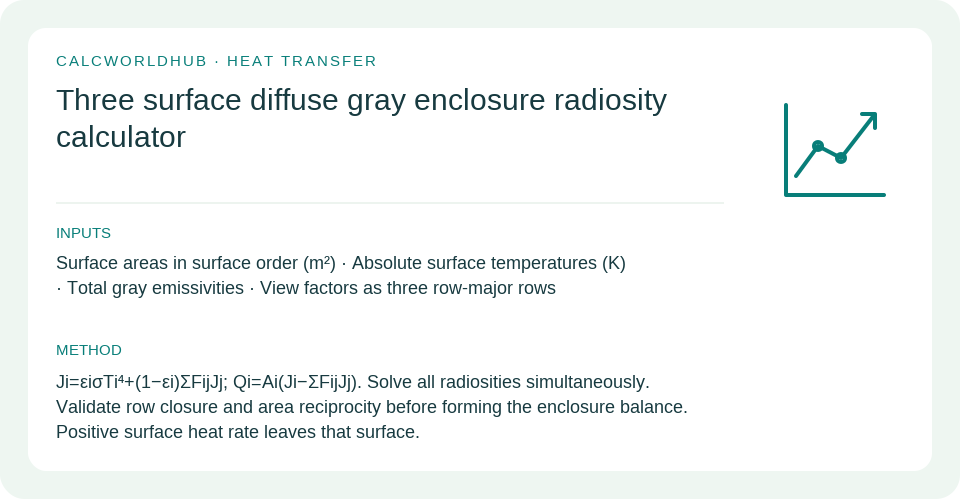
Ji=εiσTi⁴+(1−εi)ΣFijJj; Qi=Ai(Ji−ΣFijJj).
Solve all radiosities simultaneously. Validate row closure and area reciprocity before forming the enclosure balance. Positive surface heat rate leaves that surface.
What to enter
A— Surface areas in surface order (m²)- Three positive radiating areas; use the same order in temperatures, emissivities and view-factor rows. Use comma-separated values in the stated order.
T— Absolute surface temperatures (K)- Three uniform absolute temperatures, one for each opaque enclosure surface. Use comma-separated values in the stated order.
e— Total gray emissivities- Three emissivities above zero and at most one; reflected energy is retained in the enclosure. Use comma-separated values in the stated order.
F— View factors as three row-major rows- Nine nonnegative Fij values, each row summing to one. Reciprocity requires Ai Fij=Aj Fji; concave surfaces may see themselves. Use comma-separated values in the stated order.
Interpreting the result
Opaque isothermal diffuse gray surfaces, nonparticipating enclosed medium and supplied view factors. Does not calculate geometry or spectral effects.
Reading the outputs
Three signed heat rates are W. Their sum is an energy-balance residual that should be close to numerical zero.
Frequently asked questions
Can a surface view itself?
Yes if it is concave; its self-view factor belongs on the matrix diagonal.
Why are both area and view factors checked?
View factors conserve geometrical exchange only when their row sums and area reciprocity are consistent.
Does a negative heat rate mean an error?
No. It means that surface absorbs more radiation than it emits and reflects outward.
How do I use the Three surface diffuse gray enclosure radiosity calculator?
Enter Surface areas in surface order (m²), Absolute surface temperatures (K), Total gray emissivities, View factors as three row-major rows. Match the units shown beside each field and review the result together with the assumptions below.
What is a worked example of Three surface diffuse gray enclosure radiosity?
Surface areas in surface order (m²) = [1, 1, 2]; Absolute surface temperatures (K) = [700, 400, 300]; Total gray emissivities = [0.8, 0.6, 0.9]; View factors as three row-major rows = [0, 0.2, 0.8, 0.2, 0, 0.8, 0.4, 0.4, 0.2]. Net heat leaving surface 1: 9946.001749 W Net heat leaving surface 2: -925.411934 W Net heat leaving surface 3: -9020.589816 W Enclosure energy residual: -1.81898940e-12 W Three enclosure surfaces at 700, 400 and 300 K have areas 1, 1 and 2 m² with the stated reciprocal view factors. The hot surface loses 9,946.00 W while the other two absorb 925.412 and 9,020.59 W; their net heat sum is zero to rounding.
Background or definition reference: IIT NPTEL radiosity and radiation networks.
Read our calculation methodology.