Tile joint grout quantity calculator
Estimate grout mass from tiled area, tile and joint geometry, filled depth, installed grout density, and a waste allowance.
How to use this calculator
Estimate grout mass from tiled area, tile and joint geometry, filled depth, installed grout density, and a waste allowance.
- Enter Tiled area including joints (m²), Tile length (mm), Tile width (mm), Joint width (mm), then complete the remaining labeled fields. Match the units shown beside each field and review the result together with the assumptions below.
- Read the worked example below to check the expected input format and result.
- Compare another scenario by changing one input at a time. Use Reset to return to the starting values.
How the Tile joint grout quantity calculator works
Estimate grout mass from tiled area, tile and joint geometry, filled depth, installed grout density, and a waste allowance.
Inputs and units
- Tiled area including joints (m²): Total tiled surface including joint area, in m².
- Tile length (mm): Tile face length along one grid axis, in millimetres.
- Tile width (mm): Tile face width along the perpendicular grid axis, in millimetres.
- Joint width (mm): Uniform joint width between adjacent tiles, in millimetres.
- Filled joint depth (mm): Filled joint depth, in millimetres.
- Installed grout density (kg/L): Installed grout mass density, in kg/L; use product-specific data.
- Waste allowance (%): Extra quantity fraction as a percentage for waste allowance.
Formula and method
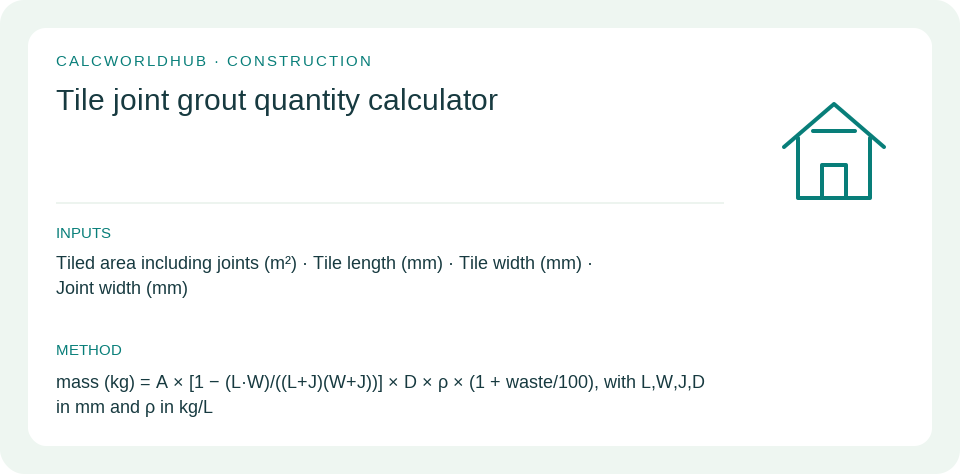
mass (kg) = A × [1 − (L·W)/((L+J)(W+J))] × D × ρ × (1 + waste/100), with L,W,J,D in mm and ρ in kg/L
Worked example
For 20 m², 300×300 mm tiles, 3 mm joints, 8 mm depth, 1.6 kg/L density, and 10% waste, the estimated quantity is about 5.55 kg.
Interpreting the result
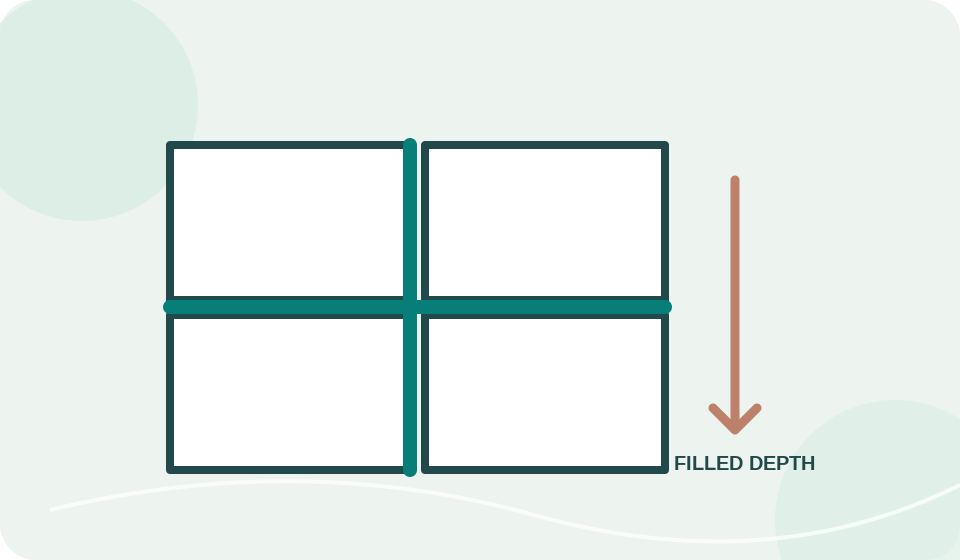
The geometry estimates the joint fraction of tiled area and multiplies it by filled depth and product density. The waste factor increases the purchase estimate after the nominal volume-to-mass calculation.
Assumptions and limits
This idealized grid assumes uniform rectangular tiles, equal straight joints, full joint depth, and no perimeter or irregular cuts. Density is product-specific; follow the grout manufacturer's coverage and mixing guidance for purchasing and installation.
Frequently asked questions
Why does the result depend on grout density?
The geometric joint volume is converted to mass using the entered installed density, so a denser product needs more mass for the same void volume.
Is the waste allowance included before or after the geometry?
It is a multiplier applied after the nominal mass estimate; it does not change the modeled joint dimensions.
How do I use the Tile joint grout quantity calculator?
Enter Tiled area including joints (m²), Tile length (mm), Tile width (mm), Joint width (mm), then complete the remaining labeled fields. Match the units shown beside each field and review the result together with the assumptions below.
What is a worked example of Tile joint grout quantity?
For 20 m², 300×300 mm tiles, 3 mm joints, 8 mm depth, 1.6 kg/L density, and 10% waste, the estimated quantity is about 5.55 kg.
What does the Tile joint grout quantity calculator calculate?
Estimate grout mass from tiled area, tile and joint geometry, filled depth, installed grout density, and a waste allowance.
See the calculation methodology.