Time-series first difference calculator
Measure the one-period change between consecutive observations in an ordered series.
Calculator
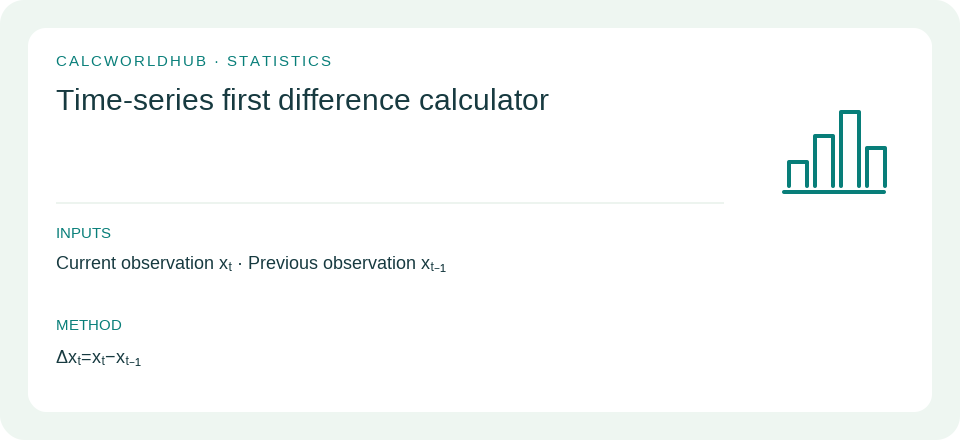
How to use this calculator
Measure the one-period change between consecutive observations in an ordered series.
- Enter Current observation xₜ, Previous observation xₜ₋₁. Match the units shown beside each field and review the result together with the assumptions below.
- Read the worked example below to check the expected input format and result.
- Compare another scenario by changing one input at a time. Use Reset to return to the starting values.
Time-series first difference calculator
Measure the one-period change between consecutive observations in an ordered series.
Inputs and units
- Current observation xₜ: Newest value in the ordered time series; it anchors the one-step change, smoothing update, or weighted window.
- Previous observation xₜ₋₁: Immediately preceding value, measured at the same time spacing and on the same scale as xₜ.
Formula and method
Δxₜ=xₜ−xₜ₋₁
Worked example
For current value 128 and previous value 120, Δxₜ=128−120=8 units.
Interpreting the result
A positive result is an increase and a negative result a decrease; it measures absolute change, not percentage growth.
Assumptions and limits
The two observations must be consecutive and measured on the same scale; negative changes are valid.
Frequently asked questions
Which inputs determine this result?
The visible inputs are Current observation xₜ, Previous observation xₜ₋₁. Each is used by the displayed formula; the calculator does not use any other hidden measurement.
When does this method apply?
The two observations must be consecutive and measured on the same scale; negative changes are valid.
How do I use the Time-series first difference calculator?
Enter Current observation xₜ, Previous observation xₜ₋₁. Match the units shown beside each field and review the result together with the assumptions below.
What is a worked example of Time-series first difference?
For current value 128 and previous value 120, Δxₜ=128−120=8 units.
What does the Time-series first difference calculator calculate?
Measure the one-period change between consecutive observations in an ordered series.
See the calculation methodology.
Good calculators show their work.
CalcWorldHub is built around clear inputs and visible assumptions. Results are estimates for planning; check official sources or your provider’s terms when exact figures matter.