How to use this calculator
Average matched changes defined as each second value minus its first value.
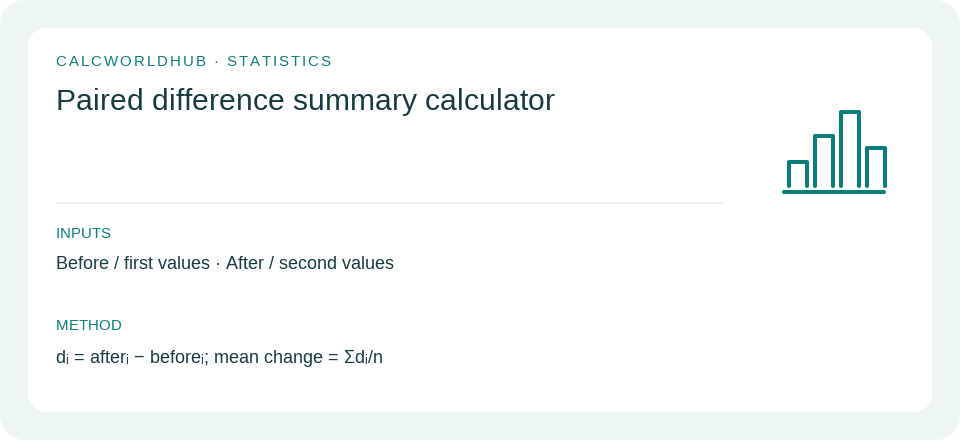
- Enter Before / first values, After / second values. Match the units shown beside each field and review the result together with the assumptions below.
- Read the worked example below to check the expected input format and result.
- Compare another scenario by changing one input at a time. Use Reset to return to the starting values.
How Paired difference summary calculator works
Average matched changes defined as each second value minus its first value.
Inputs and units
- Before / first values: First/before values in pair order.
- After / second values: Second/after values matched one-to-one with the first list.
Formula and method
dᵢ = afterᵢ − beforeᵢ; mean change = Σdᵢ/n
Worked example
Before [10,12,15,18] and after [11,14,16,21] give changes [1,2,1,3], mean 1.75 units.
Interpreting the result
A positive average means an increase from first to second; it does not by itself establish statistical significance or causality.
Assumptions and limits
Pairs must represent the same subjects/items and use the same units. Matching matters; for inference, examine the paired differences and their distribution.
Frequently asked questions
Which direction is positive?
The calculator subtracts first/before from second/after; positive means the second value is larger.
Can I use unrelated groups?
No. This summary assumes each row is a meaningful matched pair.
How do I use the Paired difference summary calculator?
Enter Before / first values, After / second values. Match the units shown beside each field and review the result together with the assumptions below.
What is a worked example of Paired difference summary?
Before [10,12,15,18] and after [11,14,16,21] give changes [1,2,1,3], mean 1.75 units.
What does the Paired difference summary calculator calculate?
Average matched changes defined as each second value minus its first value.