How to use this calculator
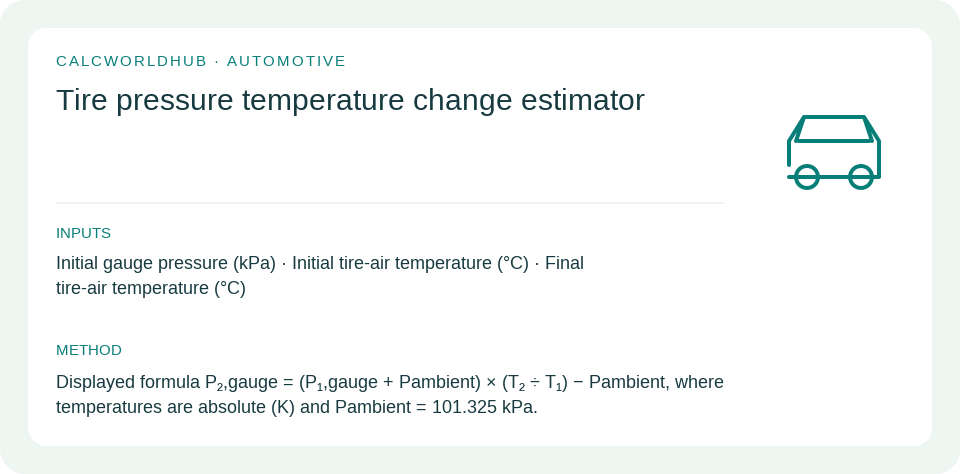
Estimate tire gauge-pressure change from an initial pressure and a temperature change using a fixed-volume ideal-gas model.
- Enter Initial gauge pressure (kPa), Initial tire-air temperature (°C), Final tire-air temperature (°C). Match the units shown beside each field and review the result together with the assumptions below.
- Read the worked example below to check the expected input format and result.
- Compare another scenario by changing one input at a time. Use Reset to return to the starting values.
How this calculation works
Air pressure in a tire changes with the temperature of the enclosed gas. This estimate converts gauge pressure to absolute pressure, applies the ideal-gas temperature ratio at constant volume, and converts back to gauge pressure.
Inputs and units
initialGaugePressure— Initial gauge pressure (kPa)- Use the gauge pressure at the initial tire-air temperature.
initialTemperature— Initial tire-air temperature (°C)- Use the estimated internal air temperature, not automatically the outdoor temperature.
finalTemperature— Final tire-air temperature (°C)- Enter the target internal air temperature for the scenario.
Formula
P₂,gauge = (P₁,gauge + Pambient) × (T₂ ÷ T₁) − Pambient, where temperatures are absolute (K) and Pambient = 101.325 kPa.
Method
Enter initial gauge pressure in kPa and initial and final tire-air temperatures in °C. Temperatures are converted to kelvin and pressure to an absolute basis before applying the ideal-gas ratio.
Worked example
At 240 kPa gauge and 20°C, cooling the enclosed air to 0°C gives approximately (240 + 101.325) × 273.15/293.15 − 101.325 = 216.71 kPa gauge under the fixed-volume model.
Assumptions and limits
The model assumes fixed tire volume, sealed air, and a uniform gas temperature. Driving heats tires through flexing and road contact, so ambient temperature alone does not predict a hot-tire reading or replace the vehicle placard's cold-pressure guidance.
Frequently asked questions
Should I release pressure from a warm tire to reach the placard value?
No. Vehicle guidance generally specifies cold tire pressure; check when tires are cold and follow the placard or owner's manual.
Does this predict pressure immediately after driving?
No. Tire flex and road heating affect internal temperature, so the model cannot infer the real hot-tire condition from outdoor air alone.
Why use absolute pressure in the equation?
Gas-law relationships use absolute pressure and absolute temperature, so gauge pressure must be shifted by ambient pressure first.
How do I use the Tire pressure temperature change estimator?
Enter Initial gauge pressure (kPa), Initial tire-air temperature (°C), Final tire-air temperature (°C). Match the units shown beside each field and review the result together with the assumptions below.
What is a worked example of Tire pressure temperature change estimator?
At 240 kPa gauge and 20°C, cooling the enclosed air to 0°C gives approximately (240 + 101.325) × 273.15/293.15 − 101.325 = 216.71 kPa gauge under the fixed-volume model.
Reference: NHTSA tire-pressure safety guidance. See our calculation methodology.