How to use this calculator
Check a loaded trailer against tow rating, available payload, and hitch tongue-weight limits.
- Enter Weight unit, Loaded trailer weight, Vehicle maximum trailer rating, Vehicle payload available before tongue load, then complete the remaining labeled fields. Match the units shown beside each field and review the result together with the assumptions below.
- Read the worked example below to check the expected input format and result.
- Compare another scenario by changing one input at a time. Use Reset to return to the starting values.
How this calculation works
A tow rating is only one constraint. This screen converts the entered tongue-load fraction into the trailer weight allowed by remaining payload and the hitch rating, then compares the loaded trailer with all three limits.
Inputs and units
unit— Weight unit- Choose one unit and use it for every weight.
trailerLoaded— Loaded trailer weight- Total loaded trailer weight in the selected unit.
towRating— Vehicle maximum trailer rating- Manufacturer rating for the towing vehicle in the selected unit.
payloadBefore— Vehicle payload available before tongue load- Remaining payload after occupants and cargo, but before trailer tongue load; zero means no payload margin.
hitchRating— Hitch maximum tongue load- Lowest applicable hitch/receiver tongue-load rating in the selected unit.
tonguePct— Assumed tongue load (% of trailer weight)- Fraction of loaded trailer weight carried on the vehicle hitch.
Formula
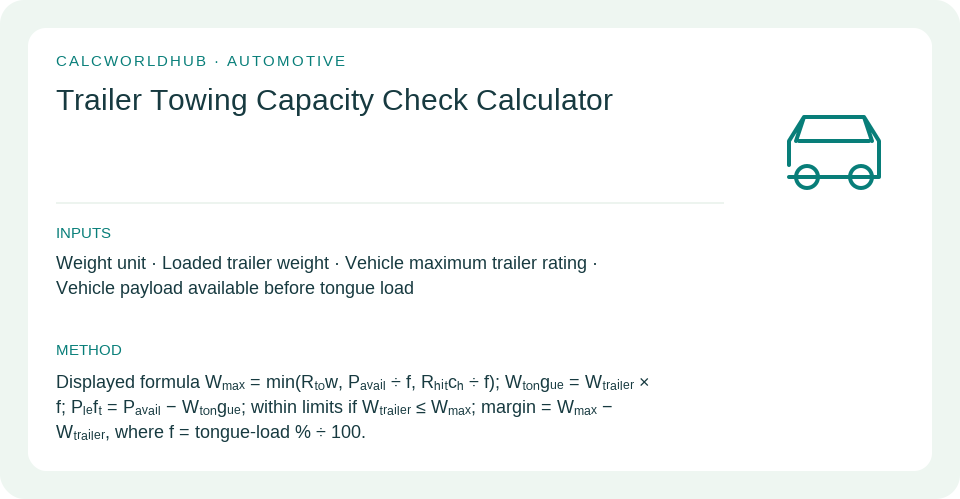
Wₘₐₓ = min(Rₜₒw, Pₐᵥₐᵢₗ ÷ f, Rₕᵢₜcₕ ÷ f); Wₜₒₙgᵤₑ = Wₜᵣₐᵢₗₑᵣ × f; Pₗₑfₜ = Pₐᵥₐᵢₗ − Wₜₒₙgᵤₑ; within limits if Wₜᵣₐᵢₗₑᵣ ≤ Wₘₐₓ; margin = Wₘₐₓ − Wₜᵣₐᵢₗₑᵣ, where f = tongue-load % ÷ 100.
Method
All weights use the same selected unit. The allowable trailer weight is the smallest of the vehicle tow rating, payload-derived limit, and hitch tongue rating converted using the entered tongue-load fraction. The check compares loaded trailer weight with this minimum.
Worked example
At 4,000 lb loaded, a 7,000 lb tow rating, 1,200 lb payload remaining, 500 lb hitch limit, and 12.5% tongue load, the maximum is 4,000 lb; the tongue load is 500 lb.
Assumptions and limits
This is a planning screen, not a vehicle-specific towing approval. It does not independently check GCWR, axle ratings, tire limits, receiver/ball ratings, braking, or manufacturer conditions; use the vehicle and hitch manuals and actual scale weights.
Frequently asked questions
Is the tow rating the only limit?
No. Payload, axle and gross-combination ratings, hitch components, tires, and manufacturer conditions can also limit a towing setup.
What does available payload mean here?
Enter the payload remaining after occupants and vehicle cargo but before adding trailer tongue load.
Does this calculator certify that my combination is safe?
No. It is a simplified screening estimate. Verify every rating and condition in the tow vehicle and hitch manuals and check actual loaded weights.
How should I choose the tongue-load percentage?
Use the fraction appropriate to your trailer type and manufacturer guidance; the entered percentage directly determines payload and hitch constraints.
How do I use the Trailer Towing Capacity Check Calculator?
Enter Weight unit, Loaded trailer weight, Vehicle maximum trailer rating, Vehicle payload available before tongue load, then complete the remaining labeled fields. Match the units shown beside each field and review the result together with the assumptions below.
Reference: Ford 2024 RV and trailer towing guide on payload, tongue load, and vehicle ratings. See our calculation methodology.