How to use this calculator
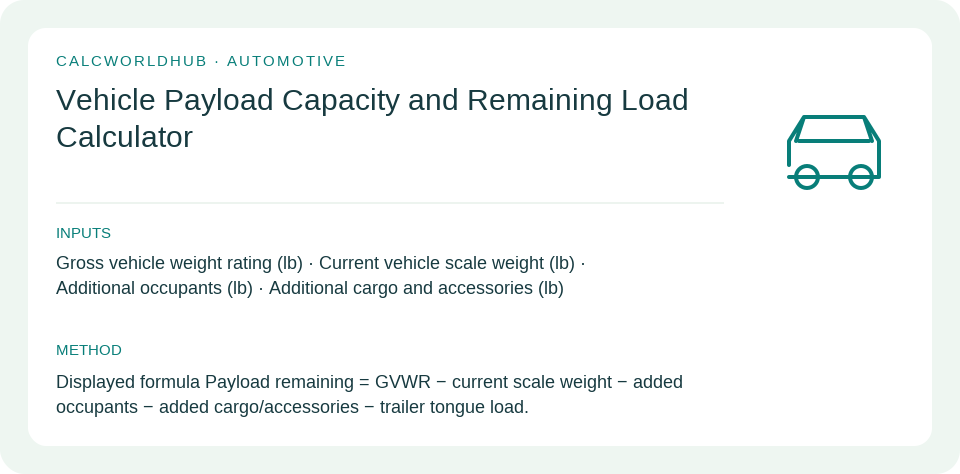
Estimate remaining vehicle payload from GVWR, scale weight, passengers, cargo, and trailer tongue load.
- Enter Gross vehicle weight rating (lb), Current vehicle scale weight (lb), Additional occupants (lb), Additional cargo and accessories (lb), then complete the remaining labeled fields. Match the units shown beside each field and review the result together with the assumptions below.
- Read the worked example below to check the expected input format and result.
- Compare another scenario by changing one input at a time. Use Reset to return to the starting values.
How this calculation works
Payload is the weight carried by the vehicle within its gross vehicle weight rating. Starting with an actual scale weight makes the estimate specific to the vehicle’s current fuel, accessories, and occupants before the planned additions are loaded.
Inputs and units
gvwr— Gross vehicle weight rating (lb)- Maximum loaded vehicle weight shown on its certification label.
scale— Current vehicle scale weight (lb)- Actual weight before adding the planned people, cargo, and tongue load.
occupants— Additional occupants (lb)- Combined weight of occupants not included in the scale reading.
cargo— Additional cargo and accessories (lb)- Planned luggage, equipment, and additions not included in the scale reading.
tongue— Trailer tongue load on vehicle (lb)- Vertical trailer load carried by the tow vehicle; enter 0 when not towing.
Formula
Payload remaining = GVWR − current scale weight − added occupants − added cargo/accessories − trailer tongue load.
Method
Use the GVWR from the vehicle certification label and a current scale weight for the vehicle before the listed additions. Enter only people or items not already included in that scale weight; include tongue load when attached to the vehicle.
Worked example
For a 6,500 lb GVWR and a 5,200 lb current scale weight, 350 lb of additional occupants, 300 lb of cargo, and 450 lb of tongue load leave 6,500 − 5,200 − 350 − 300 − 450 = 200 lb of estimated payload margin.
Assumptions and limits
This is a gross-weight screening estimate, not a towing approval. Axle, tire, hitch, and gross-combination ratings can be lower constraints; check the vehicle label and owner’s manual and weigh the loaded vehicle.
Frequently asked questions
Where do I find GVWR?
Use the vehicle certification label and owner’s manual for the specific vehicle, not a generic model-year listing.
Does payload include passengers?
Yes. People, cargo, accessories, and trailer tongue load carried by the vehicle contribute to loaded weight. Do not count anything already included in the scale reading again.
Is this the same as towing capacity?
No. Payload is carried by the vehicle; towing capacity and axle, hitch, tire, and combined-weight limits are separate ratings.
How do I use the Vehicle Payload Capacity and Remaining Load Calculator?
Enter Gross vehicle weight rating (lb), Current vehicle scale weight (lb), Additional occupants (lb), Additional cargo and accessories (lb), then complete the remaining labeled fields. Match the units shown beside each field and review the result together with the assumptions below.
What is a worked example of Vehicle Payload Capacity and Remaining Load?
For a 6,500 lb GVWR and a 5,200 lb current scale weight, 350 lb of additional occupants, 300 lb of cargo, and 450 lb of tongue load leave 6,500 − 5,200 − 350 − 300 − 450 = 200 lb of estimated payload margin.
Reference: Ford vehicle glossary for GVWR and payload definitions. See our calculation methodology.