How to use this calculator
Estimate static axle loads and longitudinal load transfer from acceleration or braking.
- Enter Vehicle mass (kg), Wheelbase (m), Center-of-gravity height (m), Longitudinal acceleration (m/s²), then complete the remaining labeled fields. Match the units shown beside each field and review the result together with the assumptions below.
- Read the worked example below to check the expected input format and result.
- Compare another scenario by changing one input at a time. Use Reset to return to the starting values.
Longitudinal vehicle axle load transfer explained
How the calculation works
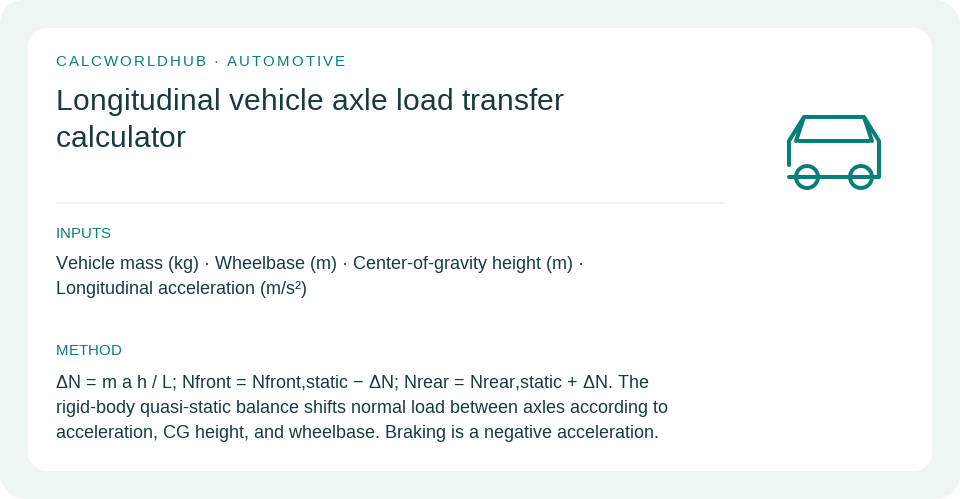
ΔN = m a h / L; Nfront = Nfront,static − ΔN; Nrear = Nrear,static + ΔN.
The rigid-body quasi-static balance shifts normal load between axles according to acceleration, CG height, and wheelbase. Braking is a negative acceleration.
Set up the calculation
mass— Vehicle mass (kg)- Total vehicle mass with occupants and cargo.
wheelbase— Wheelbase (m)- Distance between front and rear axle centers.
cg— Center-of-gravity height (m)- Height of the vehicle center of gravity above the road.
accel— Longitudinal acceleration (m/s²)- Positive for acceleration; negative for braking.
front— Static front axle fraction (%)- Level-ground static front share of total weight.
Limits of this model
Flat road, no pitch dynamics, suspension compliance, aerodynamic lift, or lateral load transfer. It does not predict tire grip or certify a vehicle setup.
Check this example
Vehicle mass (kg) = 1600; Wheelbase (m) = 2.7; Center-of-gravity height (m) = 0.55; Longitudinal acceleration (m/s²) = 3; Static front axle fraction (%) = 54.
- Load transferred rearward: 977.777778 N
- Dynamic front axle load: 7495.167822 N
- Dynamic rear axle load: 8195.472178 N
For 1,600 kg, 3 m/s² acceleration, 0.55 m CG height, and 2.7 m wheelbase, about 978 N transfers rearward.
Reading the outputs
The main result is longitudinal axle load transfer in N; supporting outputs are labeled with their own units.
Frequently asked questions
What does rearward load transfer mean here?
It is the amount shifted from the front axle to the rear by longitudinal acceleration in the rigid-body model; total normal load stays constant on a level road.
How does braking affect the sign?
Enter braking as negative longitudinal acceleration. The load-transfer term changes sign and shifts load toward the front axle.
Does the result include the static axle distribution?
The static front fraction anchors the initial front load. The calculator reports the transfer and a dynamic front-axle estimate, without suspension or pitch dynamics.
How do I use the Longitudinal vehicle axle load transfer calculator?
Enter Vehicle mass (kg), Wheelbase (m), Center-of-gravity height (m), Longitudinal acceleration (m/s²), then complete the remaining labeled fields. Match the units shown beside each field and review the result together with the assumptions below.
What is a worked example of Longitudinal vehicle axle load transfer?
Vehicle mass (kg) = 1600; Wheelbase (m) = 2.7; Center-of-gravity height (m) = 0.55; Longitudinal acceleration (m/s²) = 3; Static front axle fraction (%) = 54. Load transferred rearward: 977.777778 N Dynamic front axle load: 7495.167822 N Dynamic rear axle load: 8195.472178 N For 1,600 kg, 3 m/s² acceleration, 0.55 m CG height, and 2.7 m wheelbase, about 978 N transfers rearward.
Read our calculation methodology.