How to use this calculator
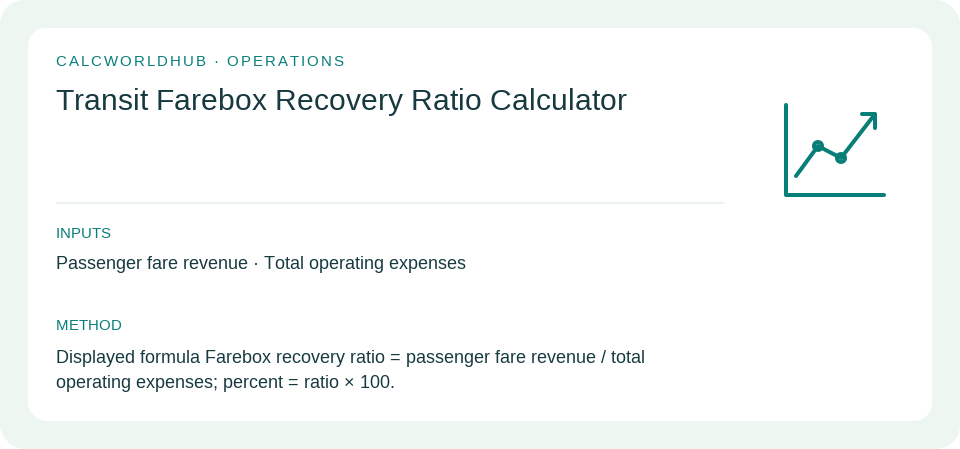
Measure transit farebox recovery as passenger fare revenue divided by operating expenses.
- Enter Passenger fare revenue, Total operating expenses. Match the units shown beside each field and review the result together with the assumptions below.
- Read the worked example below to check the expected input format and result.
- Compare another scenario by changing one input at a time. Use Reset to return to the starting values.
How this calculation works
The farebox recovery ratio expresses the share of transit operating expenses covered by passenger fare revenue. It is a cost-coverage indicator and does not include other operating revenue in the numerator.
Inputs and units
fareRevenue— Passenger fare revenue- Passenger revenue from fares for the selected period and agency.
operatingExpenses— Total operating expenses- Transit operating expenses for the same period and currency; must be positive.
Formula
Farebox recovery ratio = passenger fare revenue / total operating expenses; percent = ratio × 100.
Method
Enter fare revenue and operating expenses for the same transit agency and accounting period, using the same currency.
Worked example
If passenger fares produce $120,000 and operating expenses are $300,000, the farebox recovery ratio is 120,000/300,000 = 0.40, or 40%.
Assumptions and limits
Use passenger fare revenue and operating expenses on a consistent accounting basis. This ratio is not profit margin and does not account for capital costs, grants, or non-fare operating revenue.
Frequently asked questions
What counts as the farebox numerator?
Passenger fare revenue for the selected period; do not include grants or unrelated revenue.
Can the ratio exceed 100%?
Yes, if fare revenue exceeds operating expenses for the period.
Does it include capital costs?
No. This measure compares fares with operating expenses, not capital expenses.
How do I use the Transit Farebox Recovery Ratio Calculator?
Enter Passenger fare revenue, Total operating expenses. Match the units shown beside each field and review the result together with the assumptions below.
What is a worked example of Transit Farebox Recovery Ratio?
If passenger fares produce $120,000 and operating expenses are $300,000, the farebox recovery ratio is 120,000/300,000 = 0.40, or 40%.
Reference: Federal Transit Administration definition of farebox recovery relative to operating expenses. See our calculation methodology.