How to use this calculator
Estimate ideal propulsive velocity change from initial mass, final mass, and constant specific impulse.
- Enter Initial mass including propellant (kg), Final mass after burn (kg), Specific impulse (s). Match the units shown beside each field and review the result together with the assumptions below.
- Read the worked example below to check the expected input format and result.
- Compare another scenario by changing one input at a time. Use Reset to return to the starting values.
Tsiolkovsky ideal rocket delta v explained
For one ideal rocket stage, delta-v depends on the logarithm of initial-to-final mass and on effective exhaust velocity (specific impulse multiplied by standard gravity). Final mass includes everything remaining after the burn; gravity, drag, steering, staging and finite-burn losses are outside this equation.
Inputs, symbols, and units
m— Initial mass including propellant (kg)- Initial mass including propellant (kg).
f— Final mass after burn (kg)- Final mass after burn (kg).
i— Specific impulse (s)- Specific impulse (s).
Formula and method
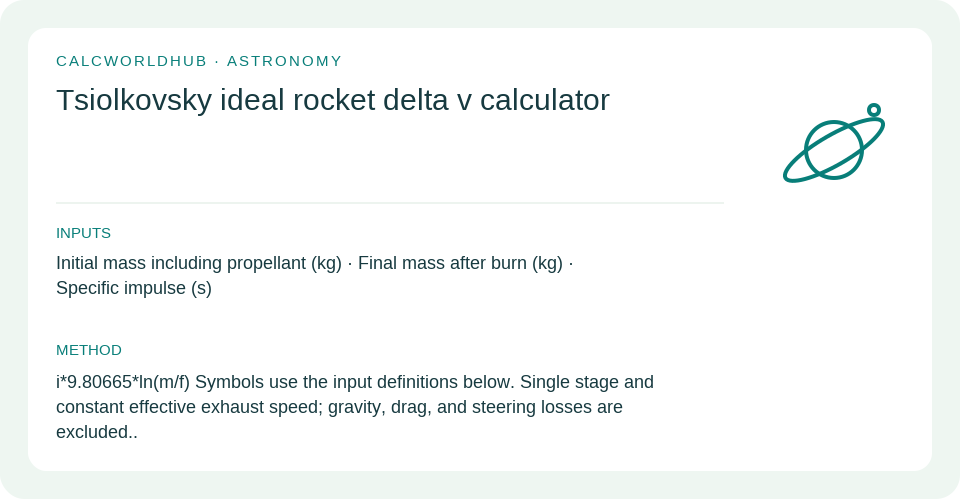
i*9.80665*ln(m/f)
Symbols use the input definitions below. Single stage and constant effective exhaust speed; gravity, drag, and steering losses are excluded..
A worked scenario
Initial mass including propellant (kg) = 1000; Final mass after burn (kg) = 400; Specific impulse (s) = 300.
- Ideal delta-v: 2695.722752 m/s
This scenario uses the stated units and assumptions. Displayed values are rounded only after calculation.
Assumptions and edge cases
Single stage and constant effective exhaust speed; gravity, drag, and steering losses are excluded.
Frequently asked questions
Does final mass include payload?
Yes, include everything remaining after the burn.
Is the result ascent performance?
No, real trajectory losses must be considered.
Can final mass exceed initial mass?
No.
How do I use the Tsiolkovsky ideal rocket delta v calculator?
Enter Initial mass including propellant (kg), Final mass after burn (kg), Specific impulse (s). Match the units shown beside each field and review the result together with the assumptions below.
What is a worked example of Tsiolkovsky ideal rocket delta v?
Initial mass including propellant (kg) = 1000; Final mass after burn (kg) = 400; Specific impulse (s) = 300. Ideal delta-v: 2695.722752 m/s This scenario uses the stated units and assumptions. Displayed values are rounded only after calculation.
Method reference: NASA gravity and rocket mechanics.
Read our calculation methodology.