How to use this calculator
Combine exhaust momentum flow with nozzle pressure force for a rocket engine.
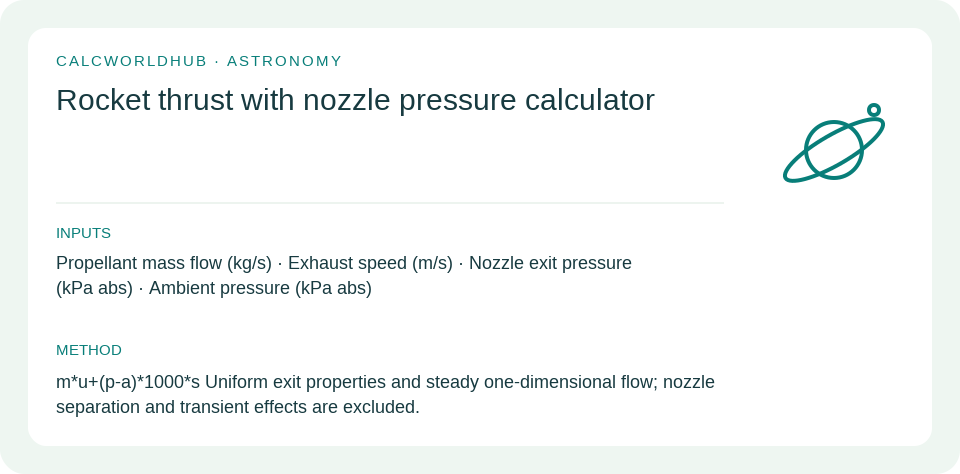
- Enter Propellant mass flow (kg/s), Exhaust speed (m/s), Nozzle exit pressure (kPa abs), Ambient pressure (kPa abs), then complete the remaining labeled fields. Match the units shown beside each field and review the result together with the assumptions below.
- Read the worked example below to check the expected input format and result.
- Compare another scenario by changing one input at a time. Use Reset to return to the starting values.
Rocket thrust with nozzle pressure explained
Combine momentum thrust with the exit-to-ambient pressure force to estimate nozzle thrust in newtons.
How the calculation works
m*u+(p-a)*1000*s
Uniform exit properties and steady one-dimensional flow; nozzle separation and transient effects are excluded.
Set up the calculation
m— Propellant mass flow (kg/s)- Propellant mass leaving the nozzle per second.
u— Exhaust speed (m/s)- Exhaust speed relative to the vehicle, in m/s.
p— Nozzle exit pressure (kPa abs)- Static pressure at the nozzle exit, entered as absolute kPa.
a— Ambient pressure (kPa abs)- Ambient absolute pressure in kPa; subtract it from exit pressure.
s— Exit area (m²)- Nozzle exit-plane area used in the pressure-thrust term.
Limits of this model
Uniform exit properties and steady one-dimensional flow; nozzle separation and transient effects are excluded.
Check this example
Propellant mass flow (kg/s) = 5; Exhaust speed (m/s) = 2500; Nozzle exit pressure (kPa abs) = 80; Ambient pressure (kPa abs) = 20; Exit area (m²) = 0.1.
- Rocket thrust with nozzle pressure: 18500 N
Interpreting the result
The result combines momentum and pressure thrust. When exit and ambient pressures match, only momentum thrust remains; when exit pressure is lower, the pressure term reduces total thrust.
Frequently asked questions
Can pressure thrust be negative?
Yes, when exit pressure is below ambient pressure.
Does this give acceleration?
No, spacecraft mass and other forces are not entered.
Are pressures absolute?
Yes, use the same pressure reference for both.
How do I use the Rocket thrust with nozzle pressure calculator?
Enter Propellant mass flow (kg/s), Exhaust speed (m/s), Nozzle exit pressure (kPa abs), Ambient pressure (kPa abs), then complete the remaining labeled fields. Match the units shown beside each field and review the result together with the assumptions below.
What is a worked example of Rocket thrust with nozzle pressure?
Propellant mass flow (kg/s) = 5; Exhaust speed (m/s) = 2500; Nozzle exit pressure (kPa abs) = 80; Ambient pressure (kPa abs) = 20; Exit area (m²) = 0.1. Rocket thrust with nozzle pressure: 18500 N
Method reference: NASA thrust equation.