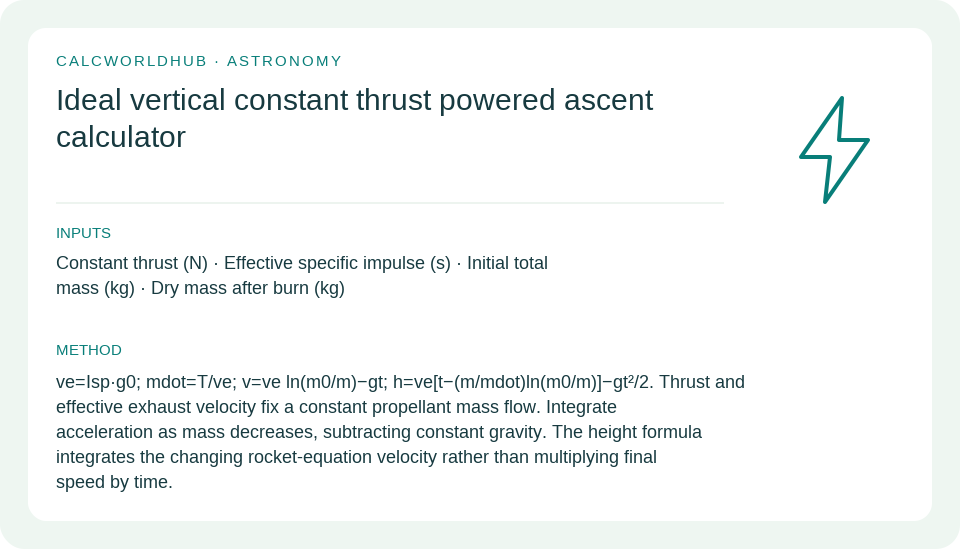
How to use this calculator
Calculate ideal vertical speed, height gain, remaining mass, and acceleration during a constant-thrust burn starting from rest.
- Enter Constant thrust (N), Effective specific impulse (s), Initial total mass (kg), Dry mass after burn (kg), then complete the remaining labeled fields. Match the units shown beside each field and review the result together with the assumptions below.
- Read the worked example below to check the expected input format and result.
- Compare another scenario by changing one input at a time. Use Reset to return to the starting values.
Ideal vertical constant thrust powered ascent explained
Use Constant thrust (N) with Effective specific impulse (s) to reproduce the sample calculation, then review the stated limits before carrying the result into another scenario.
A numerical walkthrough
Constant thrust (N) = 12000; Effective specific impulse (s) = 300; Initial total mass (kg) = 500; Dry mass after burn (kg) = 300; Constant local gravity (m/s^2) = 9.81; Time since ignition during burn (s) = 20.
- Ideal upward velocity during burn: 327.81616301 m/s
- Height gained from rest: 3122.6844475 m
- Remaining mass: 418.42270296 kg
- Constant-thrust burn duration: 49.03325 s
- Current upward acceleration: 18.86913217 m/s^2
A five-hundred-kilogram rocket loses propellant for twenty seconds while thrust remains twelve kilonewtons. Its acceleration increases as its mass falls.
The model behind the numbers
ve=Isp·g0; mdot=T/ve; v=ve ln(m0/m)−gt; h=ve[t−(m/mdot)ln(m0/m)]−gt²/2.
Thrust and effective exhaust velocity fix a constant propellant mass flow. Integrate acceleration as mass decreases, subtracting constant gravity. The height formula integrates the changing rocket-equation velocity rather than multiplying final speed by time.
What to enter
T— Constant thrust (N)- Force in newtons.
Isp— Effective specific impulse (s)- Effective specific impulse in seconds. Multiplication by conventional g0=9.80665 m/s² gives exhaust velocity.
m0— Initial total mass (kg)- Mass in kilograms.
mdry— Dry mass after burn (kg)- Final mass after propellant depletion, not propellant mass. It must be less than m0.
g— Constant local gravity (m/s^2)- Acceleration in metres per second squared.
t— Time since ignition during burn (s)- Time in seconds.
Interpreting the result
Vertical point-mass ascent from rest, constant thrust, Isp and local gravity, no drag or steering. Initial thrust must exceed weight and the query must remain within propellant burn. g0=9.80665 m/s² converts Isp; it need not equal local g.
Reading the outputs
The result is an ideal powered-phase trajectory, not a launch safety or mission performance prediction. Burnout is set by the dry-mass input.
Frequently asked questions
Why are g0 and g different?
g0 defines the conventional Isp conversion; g is the modeled local gravitational acceleration.
Can I query after burnout?
No. A separate coast-phase calculation would be required.
Does rocket equation delta v equal upward speed?
Not here. Gravity loss gt is subtracted.
How do I use the Ideal vertical constant thrust powered ascent calculator?
Enter Constant thrust (N), Effective specific impulse (s), Initial total mass (kg), Dry mass after burn (kg), then complete the remaining labeled fields. Match the units shown beside each field and review the result together with the assumptions below.
What is a worked example of Ideal vertical constant thrust powered ascent?
Constant thrust (N) = 12000; Effective specific impulse (s) = 300; Initial total mass (kg) = 500; Dry mass after burn (kg) = 300; Constant local gravity (m/s^2) = 9.81; Time since ignition during burn (s) = 20. Ideal upward velocity during burn: 327.81616301 m/s Height gained from rest: 3122.6844475 m Remaining mass: 418.42270296 kg Constant-thrust burn duration: 49.03325 s Current upward acceleration: 18.86913217 m/s^2 A five-hundred-kilogram rocket loses propellant for twenty seconds while thrust remains twelve kilonewtons. Its acceleration increases as its mass falls.
Read our calculation methodology.