How to use this calculator
Inspect steady interaction between two inputs and two outputs before choosing decentralized control pairings.
- Enter Steady gain G11, Steady gain G12, Steady gain G21, Steady gain G22. Match the units shown beside each field and review the result together with the assumptions below.
- Read the worked example below to check the expected input format and result.
- Compare another scenario by changing one input at a time. Use Reset to return to the starting values.
Two input two output relative gain pairing explained
The relative gain array estimates how closing one loop changes the steady gain seen by its partner. In a two-by-two plant, paired entries sum to one; negative entries warn that interaction can reverse a loop’s effective gain.
Inputs, symbols, and units
a— Steady gain G11- Output one response to input one.
b— Steady gain G12- Output one response to input two.
c— Steady gain G21- Output two response to input one.
d— Steady gain G22- Output two response to input two.
Formula and method
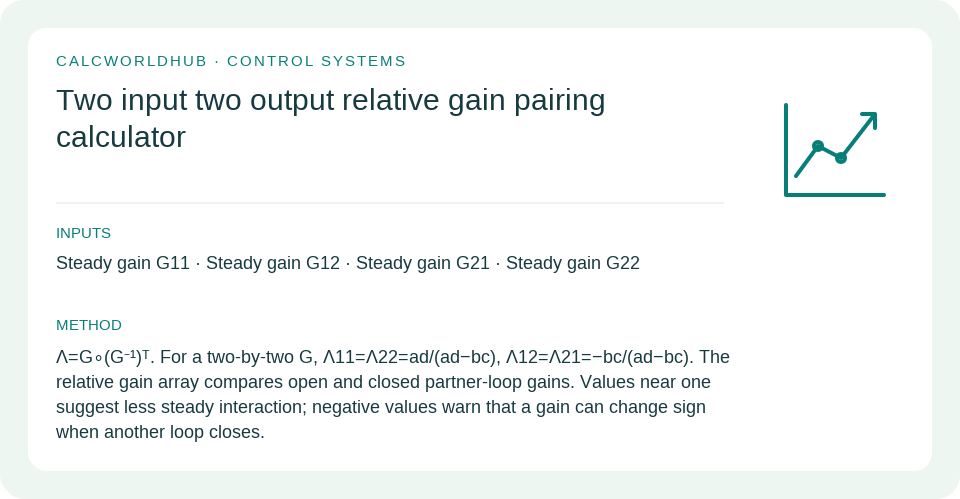
Λ=G∘(G⁻¹)ᵀ. For a two-by-two G, Λ11=Λ22=ad/(ad−bc), Λ12=Λ21=−bc/(ad−bc).
The relative gain array compares open and closed partner-loop gains. Values near one suggest less steady interaction; negative values warn that a gain can change sign when another loop closes.
A worked scenario
Steady gain G11 = 2; Steady gain G12 = 0.5; Steady gain G21 = 1; Steady gain G22 = 3.
- Diagonal relative gain: 1.090909 ratio
- Cross-pair relative gain: -0.090909 ratio
- Steady gain determinant: 5.5 mixed gain units
A plant with steady gains [[2,0.5],[1,3]] is inspected for diagonal versus crossed pairings.
Assumptions and edge cases
A steady linear interaction screen only. Delays, dynamics, actuator constraints and stability require additional analysis.
Reading the outputs
Both relative gains are dimensionless and sum to one along each row; determinant exposes singular pairing models.
Frequently asked questions
Does the RGA depend on units?
It is unchanged by separate nonzero scaling of input and output units.
Is the largest gain the best pairing?
Not necessarily; relative gain considers interaction with the partner loop.
What does a singular G mean?
The two steady input directions cannot independently set both outputs.
How do I use the Two input two output relative gain pairing calculator?
Enter Steady gain G11, Steady gain G12, Steady gain G21, Steady gain G22. Match the units shown beside each field and review the result together with the assumptions below.
What is a worked example of Two input two output relative gain pairing?
Steady gain G11 = 2; Steady gain G12 = 0.5; Steady gain G21 = 1; Steady gain G22 = 3. Diagonal relative gain: 1.090909 ratio Cross-pair relative gain: -0.090909 ratio Steady gain determinant: 5.5 mixed gain units A plant with steady gains [[2,0.5],[1,3]] is inspected for diagonal versus crossed pairings.
Read our calculation methodology.