How to use this calculator
Fit a site-specific median path-loss exponent from two measurement distances and interpolate or cautiously extrapolate it.
- Enter First reference distance (m), First measured median path loss (dB), Second reference distance (m), Second measured median path loss (dB), then complete the remaining labeled fields. Match the units shown beside each field and review the result together with the assumptions below.
- Read the worked example below to check the expected input format and result.
- Compare another scenario by changing one input at a time. Use Reset to return to the starting values.
Two-reference log-distance path-loss calibration explained
Fit the log-distance path-loss exponent from two comparable median measurements and predict median loss at another distance.
How the calculation works
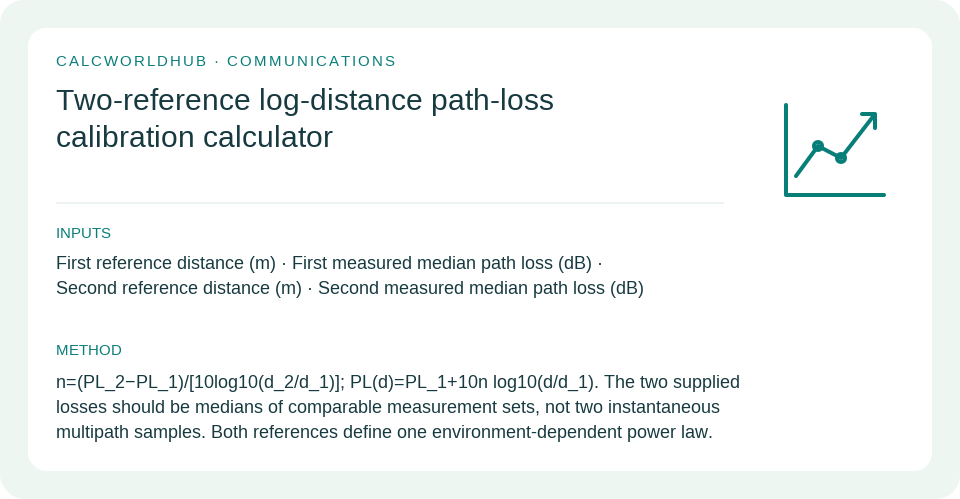
n=(PL_2−PL_1)/[10log10(d_2/d_1)]; PL(d)=PL_1+10n log10(d/d_1).
The two supplied losses should be medians of comparable measurement sets, not two instantaneous multipath samples. Both references define one environment-dependent power law.
Set up the calculation
d1— First reference distance (m)- Positive measured reference distance.
pl1— First measured median path loss (dB)- Median loss at first reference distance.
d2— Second reference distance (m)- Different positive measured reference distance.
pl2— Second measured median path loss (dB)- Median loss at second reference distance.
d— Prediction distance (m)- Distance at which to evaluate fitted median loss.
Limits of this model
No wall-count, breakpoint or frequency transfer model. A two-point fit provides no independent uncertainty estimate.
Check this example
First reference distance (m) = 10; First measured median path loss (dB) = 60; Second reference distance (m) = 100; Second measured median path loss (dB) = 90; Prediction distance (m) = 250.
- Predicted median path loss: 101.9382 dB
- Fitted path-loss exponent: 3 dimensionless
- Loss slope per distance decade: 30 dB/decade
Measured median losses of 60 dB at 10 m and 90 dB at 100 m imply exponent three; evaluate the same fitted model at 250 m.
Reading the outputs
The exponent is unitless, while the slope describes dB increase for each tenfold distance increase.
Frequently asked questions
Can two fading snapshots calibrate a reliable model?
Not usually; average or median over comparable local measurements first.
Must both distances use the same unit?
Yes; metres are requested, although the ratios are dimensionless.
Is extrapolation beyond the measurements safe?
Only when the same propagation regime plausibly continues.
How do I use the Two-reference log-distance path-loss calibration calculator?
Enter First reference distance (m), First measured median path loss (dB), Second reference distance (m), Second measured median path loss (dB), then complete the remaining labeled fields. Match the units shown beside each field and review the result together with the assumptions below.
What is a worked example of Two-reference log-distance path-loss calibration?
First reference distance (m) = 10; First measured median path loss (dB) = 60; Second reference distance (m) = 100; Second measured median path loss (dB) = 90; Prediction distance (m) = 250. Predicted median path loss: 101.9382 dB Fitted path-loss exponent: 3 dimensionless Loss slope per distance decade: 30 dB/decade Measured median losses of 60 dB at 10 m and 90 dB at 100 m imply exponent three; evaluate the same fitted model at 250 m.