Two-variable linear system solver
Solve two simultaneous linear equations for their shared x and y values.
Calculator
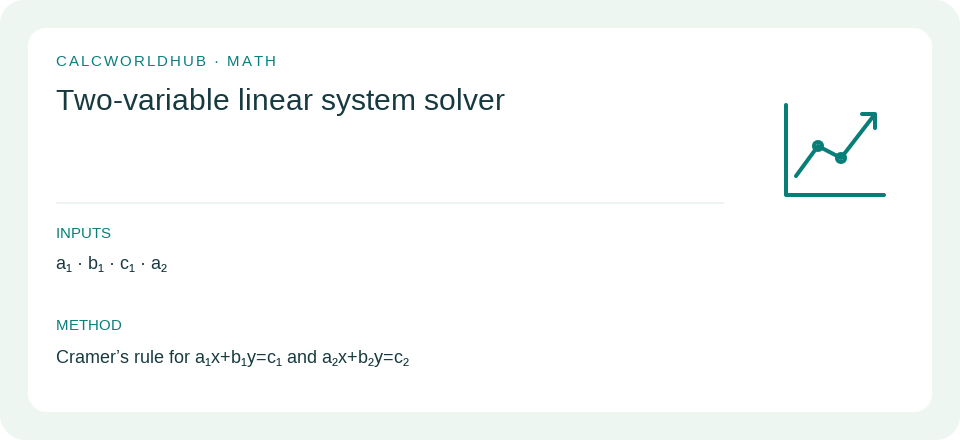
How to use this calculator
Solve two simultaneous linear equations for their shared x and y values.
- Enter a₁, b₁, c₁, a₂, then complete the remaining labeled fields. Match the units shown beside each field and review the result together with the assumptions below.
- Read the worked example below to check the expected input format and result.
- Compare another scenario by changing one input at a time. Use Reset to return to the starting values.
Two-variable linear system solver
Solve two simultaneous linear equations for their shared x and y values.
What it measures
Solve two simultaneous linear equations for their shared x and y values.
Inputs and units
- a₁: Enter the value represented by this label; keep its domain, sign, and units consistent with the formula and assumptions below.
- b₁: Enter the value represented by this label; keep its domain, sign, and units consistent with the formula and assumptions below.
- c₁: Enter the value represented by this label; keep its domain, sign, and units consistent with the formula and assumptions below.
- a₂: Enter the value represented by this label; keep its domain, sign, and units consistent with the formula and assumptions below.
- b₂: Enter the value represented by this label; keep its domain, sign, and units consistent with the formula and assumptions below.
- c₂: Enter the value represented by this label; keep its domain, sign, and units consistent with the formula and assumptions below.
Formula and method
Cramer’s rule for a₁x+b₁y=c₁ and a₂x+b₂y=c₂
Worked example
2x+y=7 and x−y=2 add to 3x=9, so x=3 and y=1; both satisfy the original equations.
Interpreting the result
A unique solution is the intersection point of two nonparallel lines. A zero determinant means the equations are parallel or dependent, so no unique pair exists.
Assumptions and limits
Coefficients and constants must be finite. The determinant a₁b₂−a₂b₁ must be nonzero for a unique solution; coefficients should use consistent variable definitions.
Frequently asked questions
How can I verify the result?
Substitute x and y into both original equations and check each equality.
What if there is no unique solution?
A zero determinant indicates parallel inconsistent equations or infinitely many dependent equations.
How do I use the Two-variable linear system solver?
Enter a₁, b₁, c₁, a₂, then complete the remaining labeled fields. Match the units shown beside each field and review the result together with the assumptions below.
What is a worked example of Two-variable linear system solver?
2x+y=7 and x−y=2 add to 3x=9, so x=3 and y=1; both satisfy the original equations.
What does the Two-variable linear system solver calculate?
Solve two simultaneous linear equations for their shared x and y values.
See the calculation methodology.
Good calculators show their work.
CalcWorldHub is built around clear inputs and visible assumptions. Results are estimates for planning; check official sources or your provider’s terms when exact figures matter.