How to use this calculator
Estimate image-plane irradiance from a uniform extended radiance source, including finite magnification and ideal off-axis falloff.
- Enter Object radiance (W/m²/sr), Lens f number, Absolute image magnification, Power transmission, then complete the remaining labeled fields. Match the units shown beside each field and review the result together with the assumptions below.
- Read the worked example below to check the expected input format and result.
- Compare another scenario by changing one input at a time. Use Reset to return to the starting values.
Uniform extended scene image irradiance explained
For a uniform extended scene, the paraxial f-number relation maps object radiance and transmission to image-plane irradiance.
How the calculation works
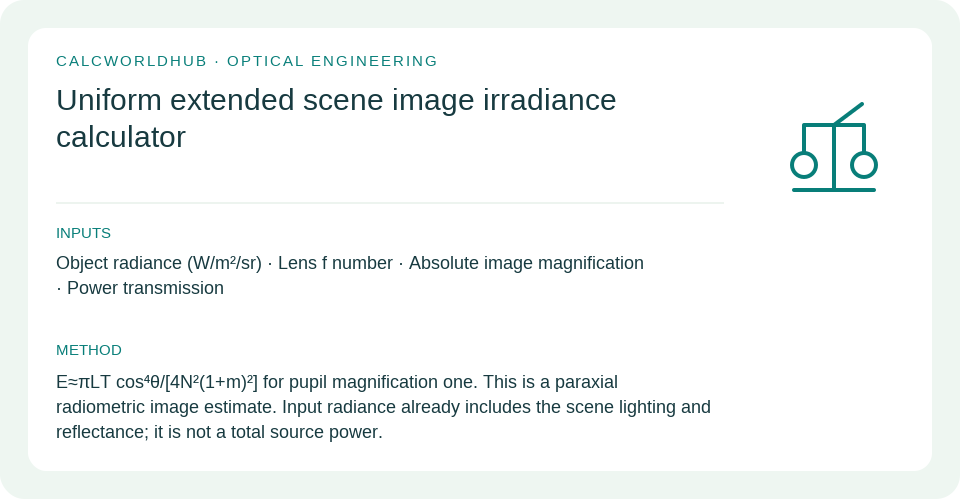
E≈πLT cos⁴θ/[4N²(1+m)²] for pupil magnification one.
This is a paraxial radiometric image estimate. Input radiance already includes the scene lighting and reflectance; it is not a total source power.
Set up the calculation
radiance— Object radiance (W/m²/sr)- Uniform object radiance reaching the entrance pupil.
fnumber— Lens f number- Nominal focal length divided by entrance pupil diameter.
magnification— Absolute image magnification- Nonnegative finite-conjugate magnification for a unit-pupil-magnification lens.
transmission— Power transmission- Total optical transmission fraction.
field— Image field angle (degrees)- Off-axis angle for the ideal cosine-fourth falloff.
Limits of this model
Unit pupil magnification, paraxial cone and no additional mechanical vignetting. Wide-angle or asymmetric lenses require measured pupil geometry.
Check this example
Object radiance (W/m²/sr) = 100; Lens f number = 4; Absolute image magnification = 0; Power transmission = 0.9; Image field angle (degrees) = 0.
- Ideal image irradiance: 4.417865 W/m²
- Effective image f number: 4
- Field illumination factor: 1
Radiance 100 W/m²/sr through a 90-percent transmitting f/4 lens at distant conjugates gives about 4.418 W/m² on axis.
Reading the outputs
Irradiance is W/m², effective image f-number and field illumination factor are dimensionless.
Frequently asked questions
Does a larger distant object make its image locally brighter?
Uniform radiance produces the same local irradiance under these assumptions; total image area changes.
Why does macro magnification reduce irradiance?
The image-side cone narrows, represented by the effective f-number.
Does cosine-fourth include lens shading corrections?
No. Real lenses may differ because of pupil distortion and mechanical vignetting.
How do I use the Uniform extended scene image irradiance calculator?
Enter Object radiance (W/m²/sr), Lens f number, Absolute image magnification, Power transmission, then complete the remaining labeled fields. Match the units shown beside each field and review the result together with the assumptions below.
What is a worked example of Uniform extended scene image irradiance?
Object radiance (W/m²/sr) = 100; Lens f number = 4; Absolute image magnification = 0; Power transmission = 0.9; Image field angle (degrees) = 0. Ideal image irradiance: 4.417865 W/m² Effective image f number: 4 Field illumination factor: 1 Radiance 100 W/m²/sr through a 90-percent transmitting f/4 lens at distant conjugates gives about 4.418 W/m² on axis.
Background or definition reference: MIT optics lecture notes.
Read our calculation methodology.