How to use this calculator
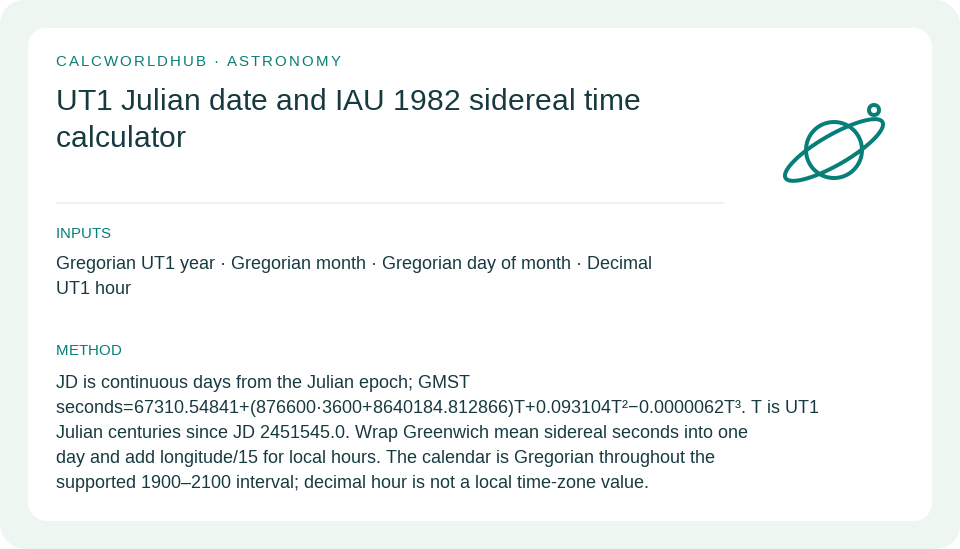
Convert a Gregorian UT1 calendar instant to Julian date, modified Julian date, and mean sidereal time under the explicit IAU 1982 model.
- Enter Gregorian UT1 year, Gregorian month, Gregorian day of month, Decimal UT1 hour, then complete the remaining labeled fields. Match the units shown beside each field and review the result together with the assumptions below.
- Read the worked example below to check the expected input format and result.
- Compare another scenario by changing one input at a time. Use Reset to return to the starting values.
UT1 Julian date and IAU 1982 sidereal time explained
How the calculation works
JD is continuous days from the Julian epoch; GMST seconds=67310.54841+(876600·3600+8640184.812866)T+0.093104T²−0.0000062T³.
T is UT1 Julian centuries since JD 2451545.0. Wrap Greenwich mean sidereal seconds into one day and add longitude/15 for local hours. The calendar is Gregorian throughout the supported 1900–2100 interval; decimal hour is not a local time-zone value.
Set up the calculation
year— Gregorian UT1 year- Gregorian calendar year of the UT1 date; the implementation supports 1900 through 2100.
month— Gregorian month- Gregorian calendar month, 1 through 12.
day— Gregorian day of month- Valid day of the selected Gregorian month; leap days are checked against the calendar.
hour— Decimal UT1 hour- Decimal UT1 hour since 00:00 on that date. For example, 12.5 means 12:30 UT1.
lon— Observer longitude east positive (degrees)- Observer longitude, east positive. It shifts local sidereal time; it does not alter the Julian date or Greenwich sidereal time.
Limits of this model
UT1 input and the older stated mean-sidereal model. No UTC-to-UT1 Earth-orientation correction, leap-second parsing, TT conversion, nutation, or apparent sidereal time. Using UTC as UT1 is an approximation whose error is not evaluated here.
Check this example
Gregorian UT1 year = 2026; Gregorian month = 10; Gregorian day of month = 16; Decimal UT1 hour = 12; Observer longitude east positive (degrees) = 24.03.
- Julian date UT1: 2461330 days
- Modified Julian date UT1: 61329.5 days
- Greenwich mean sidereal time IAU 1982: 13.6680083553 hours
- Local mean sidereal time: 15.2700083553 hours
Twelve UT1 hours on the entered October date define a Julian day fraction independently of the observer. Longitude changes only local mean sidereal time, not JD or Greenwich time.
Reading the outputs
Julian date counts from noon; modified Julian date subtracts 2400000.5. Sidereal outputs are hours in the interval zero to twenty-four.
Frequently asked questions
Can I enter my local clock hour?
Convert to UT1 first; a time-zone offset alone normally gives UTC, not UT1.
Is GMST the same as apparent sidereal time?
No. Apparent sidereal time includes additional orientation terms.
What does decimal hour mean?
For example, 12.5 means 12:30 in the supplied UT1 calendar day.
How do I use the UT1 Julian date and IAU 1982 sidereal time calculator?
Enter Gregorian UT1 year, Gregorian month, Gregorian day of month, Decimal UT1 hour, then complete the remaining labeled fields. Match the units shown beside each field and review the result together with the assumptions below.
What is a worked example of UT1 Julian date and IAU 1982 sidereal time?
Gregorian UT1 year = 2026; Gregorian month = 10; Gregorian day of month = 16; Decimal UT1 hour = 12; Observer longitude east positive (degrees) = 24.03. Julian date UT1: 2461330 days Modified Julian date UT1: 61329.5 days Greenwich mean sidereal time IAU 1982: 13.6680083553 hours Local mean sidereal time: 15.2700083553 hours Twelve UT1 hours on the entered October date define a Julian day fraction independently of the observer. Longitude changes only local mean sidereal time, not JD or Greenwich time.
Background or definition reference: IAU SOFA astronomy library and stated GMST82 model.
Read our calculation methodology.