How to use this calculator
Calculate geometric altitude and north-through-east azimuth from equatorial direction, observer latitude, and supplied local sidereal time.
- Enter Object right ascension (hours), Object declination (degrees), Observer latitude (degrees), Local sidereal time (hours). Match the units shown beside each field and review the result together with the assumptions below.
- Read the worked example below to check the expected input format and result.
- Compare another scenario by changing one input at a time. Use Reset to return to the starting values.
Equatorial to geometric altitude azimuth explained
Subtract right ascension from local sidereal time to obtain hour angle, then rotate the celestial direction into local east, north, and up components. The signs determine the azimuth quadrant; this page reports geometric altitude without atmospheric refraction.
Inputs, symbols, and units
ra— Object right ascension (hours)- Right ascension in hours, where one hour is fifteen degrees. It must use a reference consistent with LST.
dec— Object declination (degrees)- Angle in degrees, converted internally to radians.
lat— Observer latitude (degrees)- Angle in degrees, converted internally to radians.
lst— Local sidereal time (hours)- Local sidereal time in hours, not local civil clock time.
Formula and method
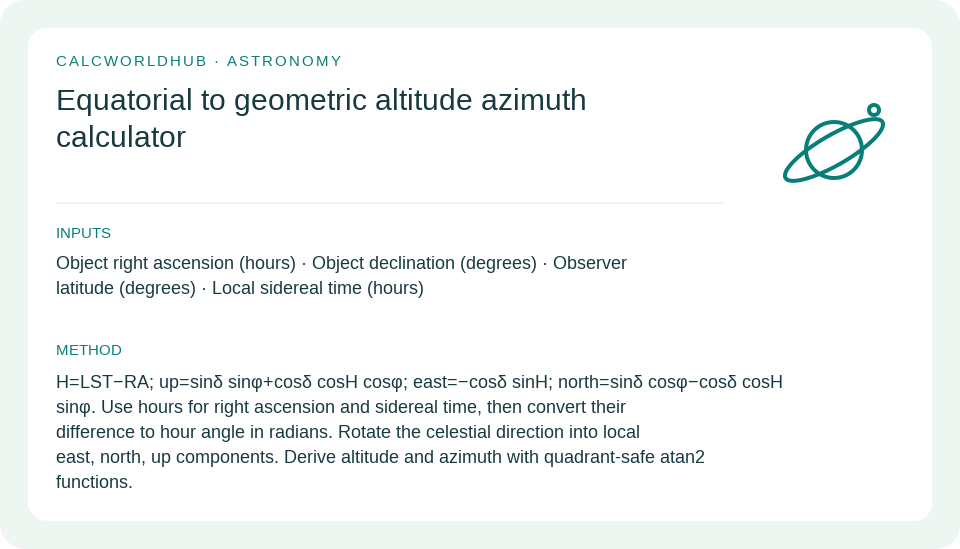
H=LST−RA; up=sinδ sinφ+cosδ cosH cosφ; east=−cosδ sinH; north=sinδ cosφ−cosδ cosH sinφ.
Use hours for right ascension and sidereal time, then convert their difference to hour angle in radians. Rotate the celestial direction into local east, north, up components. Derive altitude and azimuth with quadrant-safe atan2 functions.
A worked scenario
Object right ascension (hours) = 6; Object declination (degrees) = 20; Observer latitude (degrees) = 49.84; Local sidereal time (hours) = 8.
- Geometric altitude: 51.834172202 degrees
- Azimuth north through east: 229.494484 degrees
- Signed hour angle: 30 degrees
The local sidereal time exceeds the object’s RA by two hours, giving a positive thirty-degree hour angle. The object is west of the local meridian under this convention.
Assumptions and edge cases
A common equatorial reference for RA and LST, a point direction, and geometric horizon. No atmospheric refraction, observer elevation, parallax, aberration, or date-dependent apparent-coordinate corrections. Azimuth is undefined exactly at zenith or nadir.
Reading the outputs
Azimuth starts at north and increases through east. Negative altitude means the geometric direction is below the horizon.
Frequently asked questions
Is ordinary local clock time LST?
No. Sidereal time must be supplied or computed with the appropriate time model.
Does altitude include refraction near the horizon?
No. It is geometric.
Why can azimuth be undefined?
At zenith or nadir every horizontal compass direction is equally valid.
How do I use the Equatorial to geometric altitude azimuth calculator?
Enter Object right ascension (hours), Object declination (degrees), Observer latitude (degrees), Local sidereal time (hours). Match the units shown beside each field and review the result together with the assumptions below.
What is a worked example of Equatorial to geometric altitude azimuth?
Object right ascension (hours) = 6; Object declination (degrees) = 20; Observer latitude (degrees) = 49.84; Local sidereal time (hours) = 8. Geometric altitude: 51.834172202 degrees Azimuth north through east: 229.494484 degrees Signed hour angle: 30 degrees The local sidereal time exceeds the object’s RA by two hours, giving a positive thirty-degree hour angle. The object is west of the local meridian under this convention.
Background or definition reference: NASA JPL Horizons time and sidereal conventions.
Read our calculation methodology.