How to use this calculator
Convert measured 254 nm absorbance into sample UV transmittance and a path-length-normalized UVT estimate.
- Enter Absorbance at 254 nm, A, Optical path length (cm). Match the units shown beside each field and review the result together with the assumptions below.
- Read the worked example below to check the expected input format and result.
- Compare another scenario by changing one input at a time. Use Reset to return to the starting values.
How this calculation works
Ultraviolet transmittance (UVT) describes the fraction of light that passes through a water sample at a specified wavelength. A spectrophotometer reports absorbance over its optical path, so the same sample can have different measured absorbance in different path lengths. This calculator reports both transmittance through the entered sample path and the equivalent percent transmittance normalized to one centimetre at 254 nm.
Inputs and units
absorbance— Absorbance at 254 nm, A- Enter the measured dimensionless absorbance across the full optical path below.
pathCm— Optical path length (cm)- Length of the sample path used for the absorbance reading.
Formula
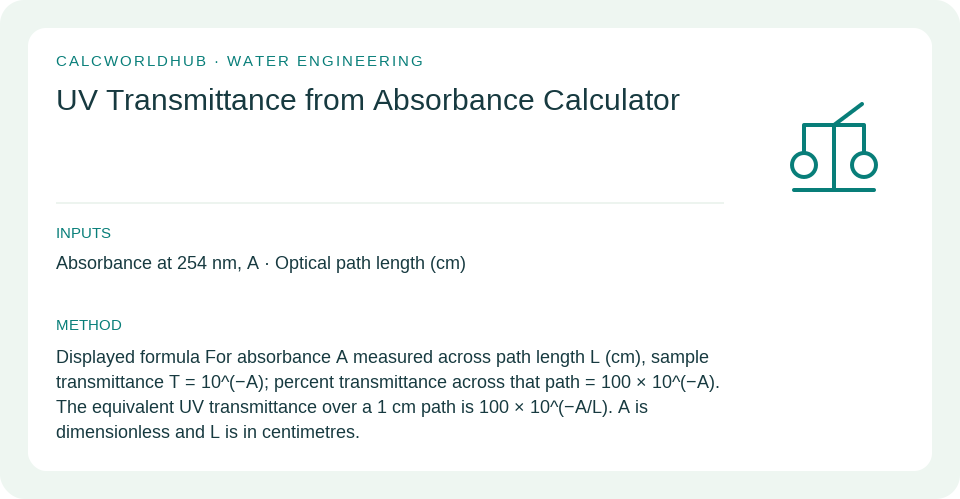
For absorbance A measured across path length L (cm), sample transmittance T = 10^(−A); percent transmittance across that path = 100 × 10^(−A). The equivalent UV transmittance over a 1 cm path is 100 × 10^(−A/L). A is dimensionless and L is in centimetres.
Method
The calculator converts the entered absorbance into the percentage transmitted through the sample cell, then divides absorbance by path length to normalize the result to a one-centimetre optical path. This is a Beer–Lambert conversion for the selected wavelength; it does not estimate microbial inactivation.
Worked example
For absorbance A = 0.30 measured through a 2 cm cell, transmittance through the cell is 100 × 10^(−0.30) ≈ 50.1187%. The equivalent one-centimetre UVT is 100 × 10^(−0.15) ≈ 70.7946% at a 1 cm path.
Assumptions and limits
The entered absorbance must correspond to the stated sample path and measurement wavelength. This page reports percent transmittance through the sample and equivalent percent transmittance at a 1 cm path; it does not determine UV dose, validate an instrument, or account for wavelength mismatch, turbidity, or sample handling.
Frequently asked questions
How do absorbance and transmittance relate?
Absorbance is the base-10 negative logarithm of the transmitted fraction: A = −log₁₀(T). Therefore the transmitted percentage is 100 × 10^(−A).
Why does the path length matter?
Absorbance accumulates with optical path length for the same absorbing sample. Normalizing A by the entered centimetres expresses a comparable one-centimetre transmittance basis.
Is UVT the same as UV dose?
No. UVT describes how much light passes through a sample at a wavelength and path. Dose also depends on irradiance and exposure time or reactor hydraulics.
Why is 254 nm used here?
254 nm is a common UV-disinfection measurement wavelength in drinking-water guidance. Use the wavelength and path length required by the instrument method for your application.
How do I use the UV Transmittance from Absorbance Calculator?
Enter Absorbance at 254 nm, A, Optical path length (cm). Match the units shown beside each field and review the result together with the assumptions below.
Reference: U.S. EPA Ultraviolet Disinfection Guidance Manual definition of UVT at a specified wavelength and path length. See our calculation methodology.