How to use this calculator
Determine whether an infinitesimal throttle pressure drop cools or heats a specified stable real-gas state.
- Enter Gas temperature (K), Molar volume (m³/mol), Attraction parameter a (Pa m⁶/mol²), Excluded molar volume b (m³/mol), then complete the remaining labeled fields. Match the units shown beside each field and review the result together with the assumptions below.
- Read the worked example below to check the expected input format and result.
- Compare another scenario by changing one input at a time. Use Reset to return to the starting values.
Van der Waals Joule Thomson coefficient and inversion explained
The local Joule–Thomson coefficient describes the temperature response to an infinitesimal pressure drop at the specified van der Waals state.
How the calculation works
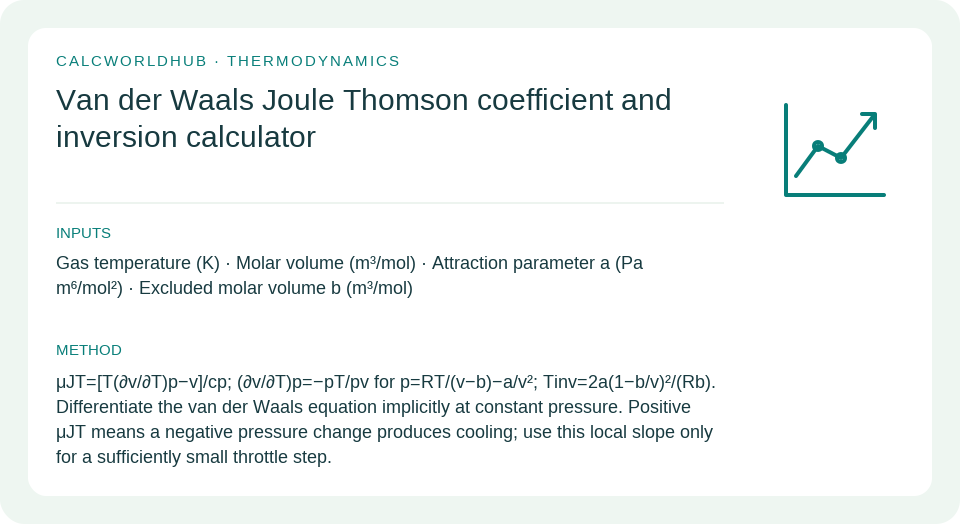
μJT=[T(∂v/∂T)p−v]/cp; (∂v/∂T)p=−pT/pv for p=RT/(v−b)−a/v²; Tinv=2a(1−b/v)²/(Rb).
Differentiate the van der Waals equation implicitly at constant pressure. Positive μJT means a negative pressure change produces cooling; use this local slope only for a sufficiently small throttle step.
Set up the calculation
T— Gas temperature (K)- Gas temperature (K). Enter the value for this state; the units shown are used without an unstated conversion.
v— Molar volume (m³/mol)- Molar volume (m³/mol). Enter the value for this state; the units shown are used without an unstated conversion.
a— Attraction parameter a (Pa m⁶/mol²)- Attraction parameter a (Pa m⁶/mol²). Enter the value for this state; the units shown are used without an unstated conversion.
b— Excluded molar volume b (m³/mol)- Excluded molar volume b (m³/mol). Enter the value for this state; the units shown are used without an unstated conversion.
cp— Local molar cp (J/mol/K)- Local molar cp (J/mol/K). Enter the value for this state; the units shown are used without an unstated conversion.
Limits of this model
Single stable van der Waals branch and supplied local molar cp. Not a finite-pressure-drop integration; excludes flashing, metastability and critical-region reliability.
Check this example
Gas temperature (K) = 300; Molar volume (m³/mol) = 0.003; Attraction parameter a (Pa m⁶/mol²) = 0.137; Excluded molar volume b (m³/mol) = 0.0000387; Local molar cp (J/mol/K) = 29.1.
- Local Joule Thomson coefficient: 0.243509 K/bar
- State pressure: 827089.86551 Pa
- Inversion temperature at this molar volume: 829.71266 K
A van der Waals gas at 300 K and molar volume 0.003 m³/mol with the entered a, b and cp has pressure 0.827090 MPa and local throttling coefficient +0.243509 K/bar. A sufficiently small pressure decrease therefore cools it; the result is not a full finite-drop outlet temperature.
Reading the outputs
Returns the local K/bar slope, state pressure and the inversion-curve temperature at the specified molar volume.
Frequently asked questions
Does positive μ mean temperature rises when pressure falls?
No. ΔT≈μΔp, so positive μ and negative Δp give cooling.
Is the inversion temperature a constant for the gas?
Not at finite density; this result is evaluated at the entered molar volume.
Can I multiply by a very large pressure drop?
No. μ changes along an isenthalpe, so a finite drop needs integration or a property package.
How do I use the Van der Waals Joule Thomson coefficient and inversion calculator?
Enter Gas temperature (K), Molar volume (m³/mol), Attraction parameter a (Pa m⁶/mol²), Excluded molar volume b (m³/mol), then complete the remaining labeled fields. Match the units shown beside each field and review the result together with the assumptions below.
What is a worked example of Van der Waals Joule Thomson coefficient and inversion?
Gas temperature (K) = 300; Molar volume (m³/mol) = 0.003; Attraction parameter a (Pa m⁶/mol²) = 0.137; Excluded molar volume b (m³/mol) = 0.0000387; Local molar cp (J/mol/K) = 29.1. Local Joule Thomson coefficient: 0.243509 K/bar State pressure: 827089.86551 Pa Inversion temperature at this molar volume: 829.71266 K A van der Waals gas at 300 K and molar volume 0.003 m³/mol with the entered a, b and cp has pressure 0.827090 MPa and local throttling coefficient +0.243509 K/bar. A sufficiently small pressure decrease therefore cools it; the result is not a full finite-drop outlet temperature.
Background or definition reference: IIT NPTEL Joule–Thomson coefficient and isenthalpes.
Read our calculation methodology.