How to use this calculator
Estimate an equilibrium constant at a second temperature using a specified reaction enthalpy.
- Enter Equilibrium constant at T1, Initial temperature T1 (K), Final temperature T2 (K), Reaction enthalpy (kJ/mol). Match the units shown beside each field and review the result together with the assumptions below.
- Read the worked example below to check the expected input format and result.
- Compare another scenario by changing one input at a time. Use Reset to return to the starting values.
Van t Hoff equilibrium temperature shift explained
For a constant reaction enthalpy, the integrated van ’t Hoff relation estimates how an equilibrium constant changes between two absolute temperatures. Positive enthalpy makes K rise on heating; the approximation weakens when enthalpy changes appreciably across the interval.
Inputs, symbols, and units
k— Equilibrium constant at T1- Positive dimensionless equilibrium constant K₁ at the initial temperature.
t— Initial temperature T1 (K)- Initial temperature T1 (K).
s— Final temperature T2 (K)- Final temperature T2 (K).
d— Reaction enthalpy (kJ/mol)- Standard reaction enthalpy for the same reaction and direction, in kJ/mol.
Formula and method
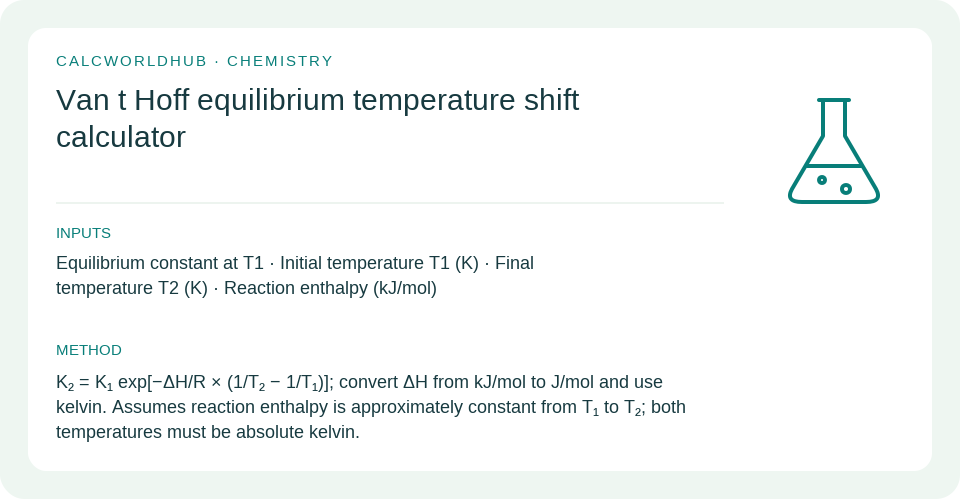
K₂ = K₁ exp[−ΔH/R × (1/T₂ − 1/T₁)]; convert ΔH from kJ/mol to J/mol and use kelvin.
Assumes reaction enthalpy is approximately constant from T₁ to T₂; both temperatures must be absolute kelvin.
A worked scenario
Equilibrium constant at T1 = 10; Initial temperature T1 (K) = 298.15; Final temperature T2 (K) = 320; Reaction enthalpy (kJ/mol) = 40.
- Van t Hoff equilibrium temperature shift: 30.094997
Here ln(K₂/K₁)=−40,000/8.3144626×(1/320−1/298.15)≈1.102; K₂=10e^1.102≈30.095.
Assumptions and edge cases
Reaction enthalpy is treated as constant over the temperature interval.
Frequently asked questions
Does positive enthalpy raise K when heated?
Yes in this model.
Can I use Celsius?
Convert to kelvin first.
Does this calculate reaction speed?
No, it concerns equilibrium.
How do I use the Van t Hoff equilibrium temperature shift calculator?
Enter Equilibrium constant at T1, Initial temperature T1 (K), Final temperature T2 (K), Reaction enthalpy (kJ/mol). Match the units shown beside each field and review the result together with the assumptions below.
What is a worked example of Van t Hoff equilibrium temperature shift?
Equilibrium constant at T1 = 10; Initial temperature T1 (K) = 298.15; Final temperature T2 (K) = 320; Reaction enthalpy (kJ/mol) = 40. Van t Hoff equilibrium temperature shift: 30.094997 Here ln(K₂/K₁)=−40,000/8.3144626×(1/320−1/298.15)≈1.102; K₂=10e^1.102≈30.095.
Read our calculation methodology.