How to use this calculator
Infer an apparent Arrhenius activation energy from two measured rates at different temperatures.
- Enter Rate constant at T1, Rate constant at T2, Temperature T1 (K), Temperature T2 (K). Match the units shown beside each field and review the result together with the assumptions below.
- Read the worked example below to check the expected input format and result.
- Compare another scenario by changing one input at a time. Use Reset to return to the starting values.
Activation energy from two rate constants explained
Infer an apparent Arrhenius activation energy from two positive rate constants measured at different absolute temperatures.
A numerical walkthrough
Rate constant at T1 = 0.01; Rate constant at T2 = 0.03; Temperature T1 (K) = 298.15; Temperature T2 (K) = 318.15.
- Apparent activation energy: 43.322687 kJ/mol
The 43.322687 kJ/mol value is an apparent two-point Arrhenius slope over 298.15–318.15 K; two temperatures cannot test whether one slope holds outside that interval.
The model behind the numbers
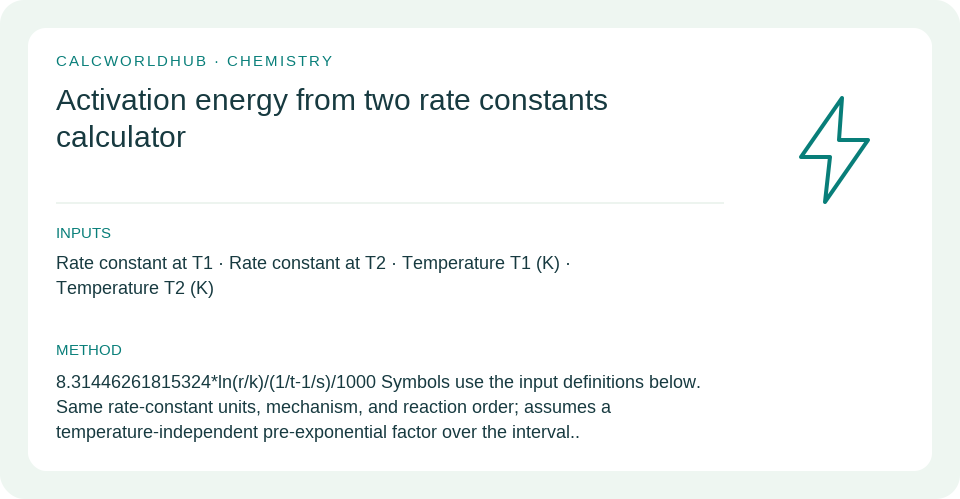
8.31446261815324*ln(r/k)/(1/t-1/s)/1000
Symbols use the input definitions below. Same rate-constant units, mechanism, and reaction order; assumes a temperature-independent pre-exponential factor over the interval..
What to enter
k— Rate constant at T1- Rate constant at T1.
r— Rate constant at T2- Rate constant at T2.
t— Temperature T1 (K)- Temperature T1 (K).
s— Temperature T2 (K)- Temperature T2 (K).
Interpreting the result
Same rate-constant units, mechanism, and reaction order; assumes a temperature-independent pre-exponential factor over the interval.
Frequently asked questions
Can the result be negative?
Yes, apparent temperature trends can yield negative values.
What if temperatures match?
Activation energy cannot be identified from equal temperatures.
Does a two-point fit prove the mechanism?
No.
How do I use the Activation energy from two rate constants calculator?
Enter Rate constant at T1, Rate constant at T2, Temperature T1 (K), Temperature T2 (K). Match the units shown beside each field and review the result together with the assumptions below.
What is a worked example of Activation energy from two rate constants?
Rate constant at T1 = 0.01; Rate constant at T2 = 0.03; Temperature T1 (K) = 298.15; Temperature T2 (K) = 318.15. Apparent activation energy: 43.322687 kJ/mol The 43.322687 kJ/mol value is an apparent two-point Arrhenius slope over 298.15–318.15 K; two temperatures cannot test whether one slope holds outside that interval.
Read our calculation methodology.