Arrhenius rate constant calculator
Estimate a reaction rate constant from its pre-exponential factor, activation energy, and temperature. Enter your values below to see the result and method.
inputs.
Related calculators
How to use this calculator
Estimate a reaction rate constant from its pre-exponential factor, activation energy, and temperature.
- Enter Pre-exponential factor A (s⁻¹), Activation energy Ea (kJ/mol), Temperature (K). Match the units shown beside each field and review the result together with the assumptions below.
- Read the worked example below to check the expected input format and result.
- Compare another scenario by changing one input at a time. Use Reset to return to the starting values.
Set the chemical conditions and units
Estimate a reaction rate constant from its pre-exponential factor, activation energy, and temperature.
Inputs and units
- Pre-exponential factor A (s⁻¹):Frequency factor in s⁻¹ for this first-order rate-constant model.
- Activation energy Ea (kJ/mol):Activation barrier in kJ/mol; it is converted to J/mol in the exponential.
- Temperature (K):Absolute temperature in kelvins, not degrees Celsius.
Equation and worked example
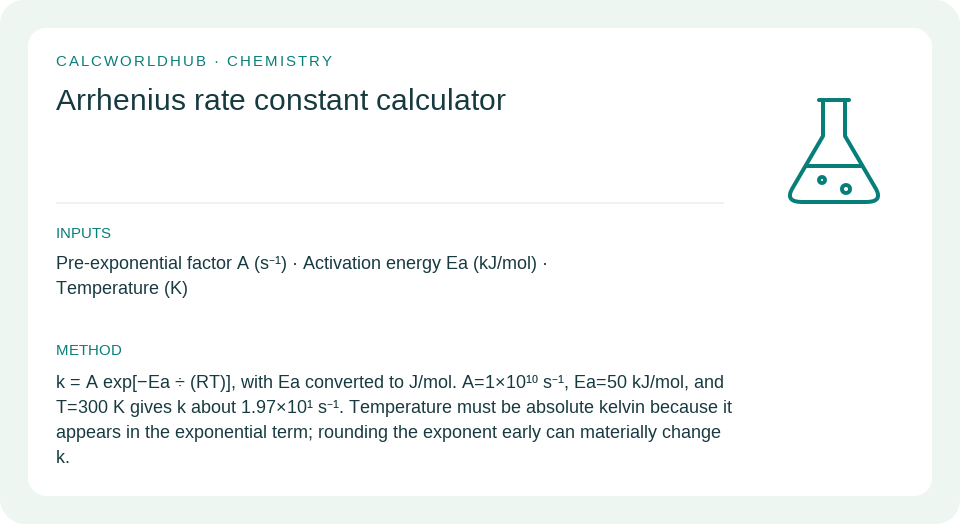
k = A exp[−Ea ÷ (RT)], with Ea converted to J/mol.
A=1×10¹⁰ s⁻¹, Ea=50 kJ/mol, and T=300 K gives k about 1.97×10¹ s⁻¹.
Temperature must be absolute kelvin because it appears in the exponential term; rounding the exponent early can materially change k.
Using the result
Because temperature appears in the Arrhenius exponential, the rate constant changes nonlinearly with T; A and Ea must describe the same reaction model.
Assumptions and limitations
Uses the Arrhenius model and the same reaction pathway; the pre-exponential factor units must match the reaction order.
Source and method
The Arrhenius equation relates A, activation energy, absolute temperature, and the rate constant. OpenStax Chemistry 2e — Collision Theory.
Frequently asked questions
Which units should I use for activation energy and temperature?
Enter activation energy in kJ/mol as labeled and absolute temperature in kelvins. The handler converts Ea to J/mol before dividing by R=8.314462618 J·mol⁻¹·K⁻¹.
What does the pre-exponential factor represent?
A is the frequency factor for the reaction model and carries the same units as the rate constant. This page does not estimate A from experimental data.
When is a concentration-based first-order rate estimate more useful?
Use the Arrhenius model when A, Ea, and T are known and you want k at that temperature. Use concentration-versus-time data when you need to estimate k empirically for a first-order reaction.
How do I use the Arrhenius rate constant calculator?
Enter Pre-exponential factor A (s⁻¹), Activation energy Ea (kJ/mol), Temperature (K). Match the units shown beside each field and review the result together with the assumptions below.
What is a worked example of Arrhenius rate constant?
k = A exp[−Ea ÷ (RT)], with Ea converted to J/mol. A=1×10¹⁰ s⁻¹, Ea=50 kJ/mol, and T=300 K gives k about 1.97×10¹ s⁻¹. Temperature must be absolute kelvin because it appears in the exponential term; rounding the exponent early can materially change k.
Read the calculation methodology and privacy policy.