First-order instantaneous reaction rate calculator
Use the current concentration and a first-order rate constant.
Calculator
How to use this calculator
Calculate first-order reaction rate magnitude from a rate constant and current concentration.
- Enter Rate constant k (1/s), Current concentration C (mol/L). Match the units shown beside each field and review the result together with the assumptions below.
- Read the worked example below to check the expected input format and result.
- Compare another scenario by changing one input at a time. Use Reset to return to the starting values.
Calculate rate from k and the current concentration
For a first-order reaction in one reactant, the instantaneous rate magnitude is proportional to that reactant’s current concentration.
Inputs and units
- Rate constant k (1/s): Use a first-order rate constant in inverse seconds.
- Current concentration C (mol/L): Enter the concentration at the instant where the rate is evaluated.
Formula and method
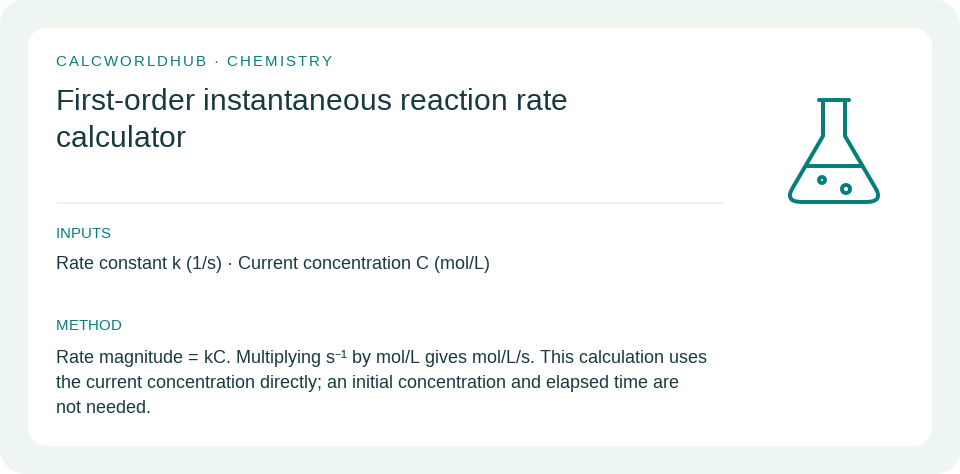
Rate magnitude = kC. Multiplying s⁻¹ by mol/L gives mol/L/s. This calculation uses the current concentration directly; an initial concentration and elapsed time are not needed.
Worked example
With k = 0.15 s⁻¹ and C = 0.325 mol/L, rate = 0.15 × 0.325 = 0.04875 mol/L/s.
Interpreting the result
The rate is the modeled disappearance-rate magnitude at that concentration. If concentration falls, a first-order rate falls in the same proportion.
Assumptions and limits
The formula assumes the reaction is first order under the conditions represented by k. A measured reaction may have a different rate law, units, or sign convention.
Method references
Frequently asked questions
Do I need the initial concentration and elapsed time?
No. This page calculates rate from the current concentration. Use a first-order concentration model to estimate C from an initial value and elapsed time.
Why is the rate shown as a positive number?
It reports the magnitude of the disappearance rate; the signed concentration change for a disappearing reactant is negative.
How do I use the First-order instantaneous reaction rate calculator?
Enter Rate constant k (1/s), Current concentration C (mol/L). Match the units shown beside each field and review the result together with the assumptions below.
What is a worked example of First-order instantaneous reaction rate?
With k = 0.15 s⁻¹ and C = 0.325 mol/L, rate = 0.15 × 0.325 = 0.04875 mol/L/s.
What does the First-order instantaneous reaction rate calculator calculate?
Calculate first-order reaction rate magnitude from a rate constant and current concentration.
Good calculators show their work.
CalcWorldHub is built around clear inputs and visible assumptions. Results are estimates for planning; check official sources or your provider’s terms when exact figures matter.