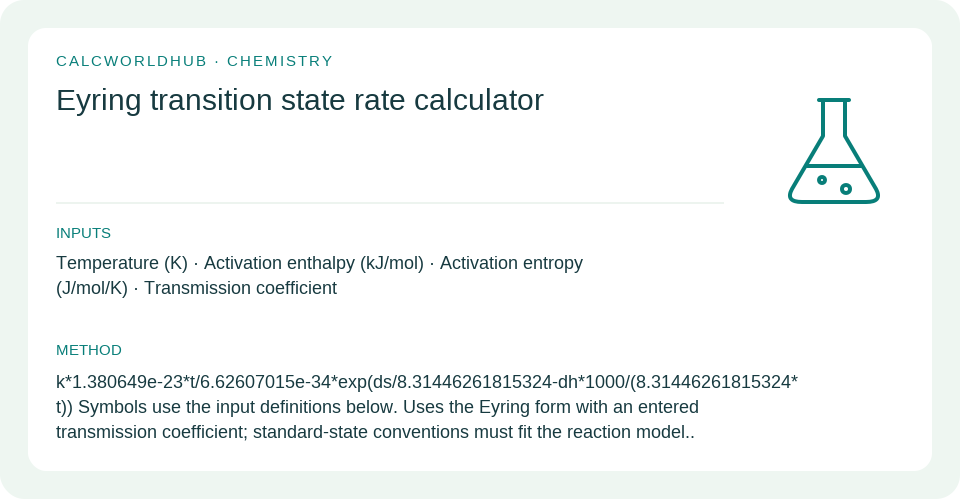
How to use this calculator
Estimate a first-order transition-state rate from activation enthalpy and entropy.
- Enter Temperature (K), Activation enthalpy (kJ/mol), Activation entropy (J/mol/K), Transmission coefficient. Match the units shown beside each field and review the result together with the assumptions below.
- Read the worked example below to check the expected input format and result.
- Compare another scenario by changing one input at a time. Use Reset to return to the starting values.
Eyring transition state rate explained
Inputs, symbols, and units
t— Temperature (K)- Temperature (K).
dh— Activation enthalpy (kJ/mol)- Activation enthalpy (kJ/mol).
ds— Activation entropy (J/mol/K)- Activation entropy (J/mol/K).
k— Transmission coefficient- Transmission coefficient.
Formula and method
k*1.380649e-23*t/6.62607015e-34*exp(ds/8.31446261815324-dh*1000/(8.31446261815324*t))
Symbols use the input definitions below. Uses the Eyring form with an entered transmission coefficient; standard-state conventions must fit the reaction model..
A worked scenario
Temperature (K) = 298.15; Activation enthalpy (kJ/mol) = 60; Activation entropy (J/mol/K) = -20; Transmission coefficient = 1.
- Eyring transition state rate: 17.260145 s⁻¹
The reported s⁻¹ value is a first-order rate constant; it is not a reaction half-life without specifying the kinetic model.
Assumptions and edge cases
Uses the Eyring form with an entered transmission coefficient; standard-state conventions must fit the reaction model.
Frequently asked questions
Is this suitable for every reaction order?
The displayed s⁻¹ form is first order; other orders require standard-state factors.
Is activation enthalpy identical to Arrhenius energy?
No, they are related but different quantities.
What does transmission coefficient mean?
It scales successful barrier crossings in the chosen model.
How do I use the Eyring transition state rate calculator?
Enter Temperature (K), Activation enthalpy (kJ/mol), Activation entropy (J/mol/K), Transmission coefficient. Match the units shown beside each field and review the result together with the assumptions below.
What is a worked example of Eyring transition state rate?
Temperature (K) = 298.15; Activation enthalpy (kJ/mol) = 60; Activation entropy (J/mol/K) = -20; Transmission coefficient = 1. Eyring transition state rate: 17.260145 s⁻¹ The reported s⁻¹ value is a first-order rate constant; it is not a reaction half-life without specifying the kinetic model.
Read our calculation methodology.