How to use this calculator
Combine aerodynamic drag, tire rolling resistance, and road grade into steady tractive force and wheel power.
- Enter Vehicle mass (kg), Road speed (km/h), Rolling resistance coefficient, Air density (kg/m³), then complete the remaining labeled fields. Match the units shown beside each field and review the result together with the assumptions below.
- Read the worked example below to check the expected input format and result.
- Compare another scenario by changing one input at a time. Use Reset to return to the starting values.
Vehicle steady road-load power from drag rolling resistance and grade explained
At constant speed, the wheel force is the sum of rolling resistance, aerodynamic drag, and the component of vehicle weight along the road. Convert road speed from km/h to m/s before multiplying force by speed; uphill grade increases demand and downhill grade can make signed wheel power negative.
Inputs, symbols, and units
mass— Vehicle mass (kg)- Loaded vehicle mass.
speed— Road speed (km/h)- Constant ground speed.
crr— Rolling resistance coefficient- Effective coefficient for the tire and surface.
rho— Air density (kg/m³)- Density of air at the modeled condition.
cd— Drag coefficient- Dimensionless aerodynamic drag coefficient.
area— Frontal area (m²)- Vehicle projected frontal area.
grade— Road grade (%)- Positive for uphill, negative downhill; percent, not degrees.
Formula and method
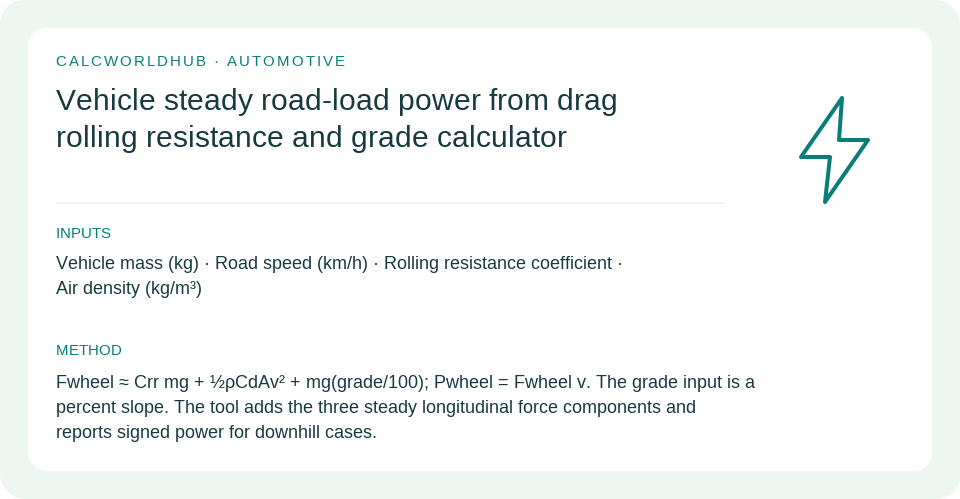
Fwheel ≈ Crr mg + ½ρCdAv² + mg(grade/100); Pwheel = Fwheel v.
The grade input is a percent slope. The tool adds the three steady longitudinal force components and reports signed power for downhill cases.
A worked scenario
Vehicle mass (kg) = 1800; Road speed (km/h) = 80; Rolling resistance coefficient = 0.012; Air density (kg/m³) = 1.2; Drag coefficient = 0.31; Frontal area (m²) = 2.25; Road grade (%) = 5.
- Total steady tractive force: 1301.088807 N
- Wheel power required: 28.913085 kW
- Rolling resistance force: 211.82364 N
- Aerodynamic drag force: 206.666667 N
- Grade force: 882.5985 N
At 80 km/h for the entered 1,800 kg vehicle on a 5% grade, the estimated wheel demand includes about 883 N of grade force and 28.2 kW total.
Assumptions and edge cases
No acceleration, cornering, wind, tire slip, accessories, or transmission efficiency is modeled. A negative downhill power means the vehicle could be overhauling the wheels.
Reading the outputs
The main result is steady road-load power in kW; supporting outputs are labeled with their own units. Use the units shown beside each input and result.
Frequently asked questions
What does the vehicle steady road-load power from drag rolling resistance and grade calculate?
At 80 km/h for the entered 1,800 kg vehicle on a 5% grade, the estimated wheel demand includes about 883 N of grade force and 28.2 kW total.
Which inputs most affect steady road-load power in kw?
The grade input is a percent slope. The tool adds the three steady longitudinal force components and reports signed power for downhill cases.
Can this result replace a site-specific or measured value?
No acceleration, cornering, wind, tire slip, accessories, or transmission efficiency is modeled. A negative downhill power means the vehicle could be overhauling the wheels.
How do I use the Vehicle steady road-load power from drag rolling resistance and grade calculator?
Enter Vehicle mass (kg), Road speed (km/h), Rolling resistance coefficient, Air density (kg/m³), then complete the remaining labeled fields. Match the units shown beside each field and review the result together with the assumptions below.
What is a worked example of Vehicle steady road-load power from drag rolling resistance and grade?
Vehicle mass (kg) = 1800; Road speed (km/h) = 80; Rolling resistance coefficient = 0.012; Air density (kg/m³) = 1.2; Drag coefficient = 0.31; Frontal area (m²) = 2.25; Road grade (%) = 5. Total steady tractive force: 1301.088807 N Wheel power required: 28.913085 kW Rolling resistance force: 211.82364 N Aerodynamic drag force: 206.666667 N Grade force: 882.5985 N At 80 km/h for the entered 1,800 kg vehicle on a 5% grade, the estimated wheel demand includes about 883 N of grade force and 28.2 kW total.
Read our calculation methodology.