How to use this calculator
Estimate VoIP bandwidth per call from codec rate, packetization, and network headers, then check link capacity.
- Enter Codec payload rate (kbps), Packetization interval (ms), IP + UDP + RTP headers (bytes/packet), Link-layer overhead (bytes/packet), then complete the remaining labeled fields. Match the units shown beside each field and review the result together with the assumptions below.
- Read the worked example below to check the expected input format and result.
- Compare another scenario by changing one input at a time. Use Reset to return to the starting values.
How this calculation works
A voice codec rate counts the encoded speech payload, while each transmitted packet also carries protocol and link framing bytes. This planner converts the payload interval into bytes per packet, adds the headers you enter, and estimates how many one-way media streams fit after a link reserve. It is intended for a quick capacity check when designing or reviewing a packet-voice link.
Inputs and units
codecRateKbps— Codec payload rate (kbps)- Use the negotiated codec payload rate, such as 64 kbps for G.711 or 8 kbps for G.729.
packetizationMs— Packetization interval (ms)- Milliseconds of encoded voice placed in each RTP packet.
networkHeaderBytes— IP + UDP + RTP headers (bytes/packet)- IPv4/UDP/RTP without header compression is commonly 20 + 8 + 12 bytes.
linkHeaderBytes— Link-layer overhead (bytes/packet)- Set to the relevant link framing; 18 bytes is Cisco's Ethernet header plus FCS example.
callCount— Simultaneous calls- Number of one-way media streams to budget on this link direction.
linkCapacityKbps— Link capacity per direction (kbps)- Available capacity in one direction; full-duplex links have a separate capacity in the opposite direction.
reservePct— Capacity held in reserve (%)- The share kept free for variability and other traffic.
Formula
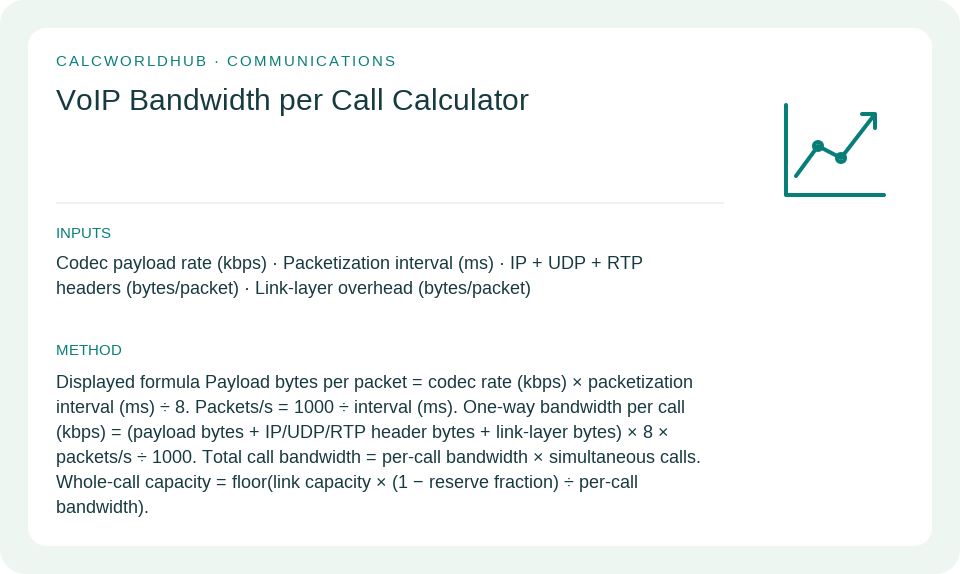
Payload bytes per packet = codec rate (kbps) × packetization interval (ms) ÷ 8. Packets/s = 1000 ÷ interval (ms). One-way bandwidth per call (kbps) = (payload bytes + IP/UDP/RTP header bytes + link-layer bytes) × 8 × packets/s ÷ 1000. Total call bandwidth = per-call bandwidth × simultaneous calls. Whole-call capacity = floor(link capacity × (1 − reserve fraction) ÷ per-call bandwidth).
Method
The packet payload is computed from codec bit rate and the packetization interval. The tool adds the IP/UDP/RTP and link-layer byte counts for every packet, converts bits per second to kilobits per second, and compares the result with the link capacity after the reserve percentage.
Worked example
For a 64 kbps G.711 stream with 20 ms packets, 40 IP/UDP/RTP header bytes and 18 Ethernet bytes, payload is 160 bytes and packet rate is 50 packets/s. The estimate is (160 + 40 + 18) × 8 × 50 = 87.2 kbps per one-way call. Ten calls use 872 kbps; a 1,000 kbps link with 20% reserved has room for 9 whole calls.
Assumptions and limits
The link capacity is interpreted per direction. Full-duplex Ethernet carries that rate independently in each direction. Actual overhead varies with Layer 2 encapsulation, VLAN tagging, security, tunneling, and voice activity detection; enter the applicable overhead for the path. The estimate does not include signaling traffic or competing non-voice traffic unless represented by the reserve.
Frequently asked questions
Why is the result higher than the codec rate?
Every packet adds protocol and link framing bytes. The overhead matters more for low-rate codecs or shorter packetization intervals because more packets are sent each second.
What changes when packetization is longer?
A longer interval puts more voice bytes in each packet and usually reduces bandwidth overhead, but it also increases packetization delay. Use the interval negotiated by the endpoints.
Does this include both directions of a call?
The displayed call rate is for one media direction. A full-duplex link has separate send and receive capacity; use the applicable direction or sum directions only when the link is shared half-duplex.
Can I count on voice activity detection to reduce capacity?
No. Silence suppression varies by call and network conditions. This estimate budgets every configured call continuously so a specific interval does not depend on average silence savings.
How do I use the VoIP Bandwidth per Call Calculator?
Enter Codec payload rate (kbps), Packetization interval (ms), IP + UDP + RTP headers (bytes/packet), Link-layer overhead (bytes/packet), then complete the remaining labeled fields. Match the units shown beside each field and review the result together with the assumptions below.
Reference: Cisco voice bandwidth calculation, including packetization and Ethernet encapsulation examples. See our calculation methodology.