How to use this calculator
Calculate putaway handling units per direct labor-hour for a consistent receiving and storage workflow.
- Enter Handling units put away, Direct putaway labor-hours. Match the units shown beside each field and review the result together with the assumptions below.
- Read the worked example below to check the expected input format and result.
- Compare another scenario by changing one input at a time. Use Reset to return to the starting values.
How this calculation works
Putaway productivity measures the rate at which received handling units are moved into their assigned storage locations. Divide the same unit type completed by the direct labor-hours spent on that putaway work, and keep the warehouse area and shift definition consistent.
Inputs and units
unitsPutAway— Handling units put away- Count completed units using one consistent handling-unit definition for the selected work.
directLaborHours— Direct putaway labor-hours- Sum direct labor-hours used for the same completed putaway units.
Formula
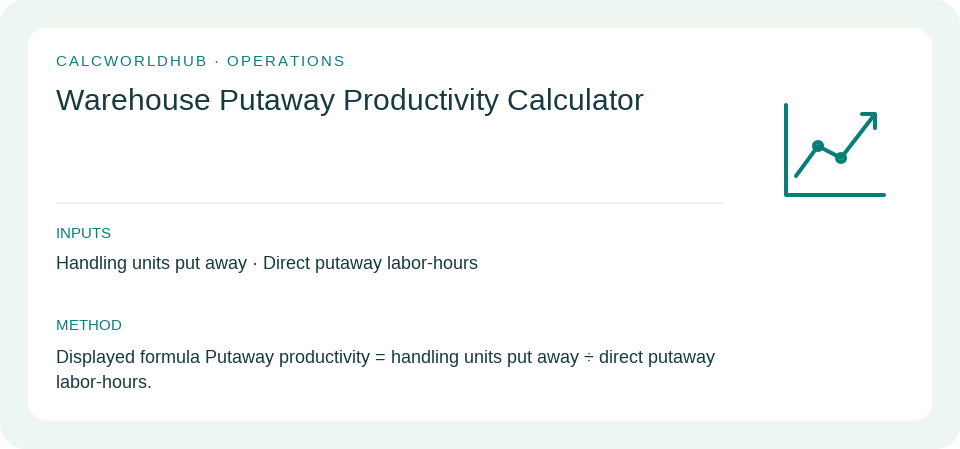
Putaway productivity = handling units put away ÷ direct putaway labor-hours.
Method
Enter a single consistent handling unit, such as pallets, cases, or cartons, plus direct labor-hours for the matching completed work. Do not mix unlike units or include unrelated receiving and travel labor unless your metric definition includes it.
Worked example
If a team puts away 720 pallets using 24 direct labor-hours, productivity is 30.00 pallets per labor-hour, or 3.33 labor-hours per 100 pallets.
Assumptions and limits
This is a throughput-per-labor-hour measure. It is not putaway accuracy, dock-to-stock elapsed time, or an employee performance standard; compare only like unit types and work scopes.
Frequently asked questions
Can I use cases instead of pallets?
Yes, but keep one handling-unit type consistent across the numerator and comparisons.
Should indirect labor be included?
Use the labor scope defined for your KPI and apply it consistently; this example uses direct putaway labor.
Is this a dock-to-stock time?
No. This divides completed handling units by labor-hours; dock-to-stock is an elapsed-time measure.
How do I use the Warehouse Putaway Productivity Calculator?
Enter Handling units put away, Direct putaway labor-hours. Match the units shown beside each field and review the result together with the assumptions below.
What is a worked example of Warehouse Putaway Productivity?
If a team puts away 720 pallets using 24 direct labor-hours, productivity is 30.00 pallets per labor-hour, or 3.33 labor-hours per 100 pallets.
Read our calculation methodology.