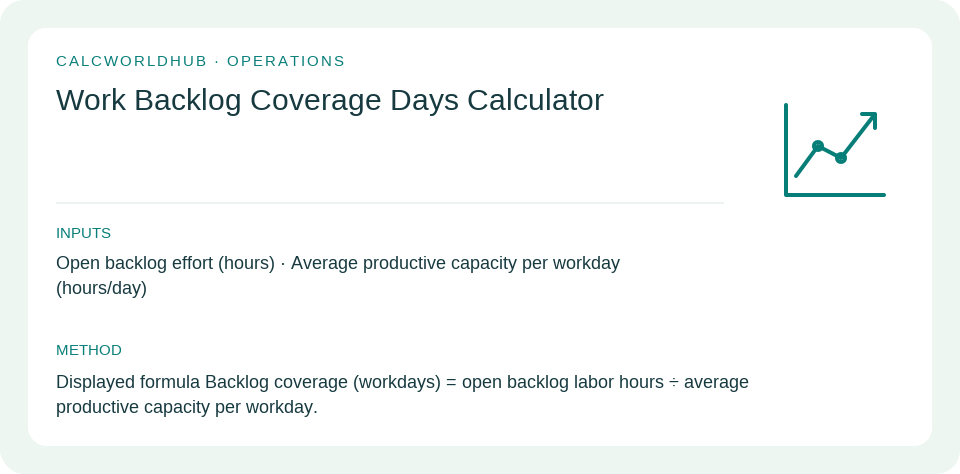
How to use this calculator
Estimate workdays to clear a measured labor-hour backlog at current daily capacity.
- Enter Open backlog effort (hours), Average productive capacity per workday (hours/day). Match the units shown beside each field and review the result together with the assumptions below.
- Read the worked example below to check the expected input format and result.
- Compare another scenario by changing one input at a time. Use Reset to return to the starting values.
How this calculation works
Enter remaining backlog effort and average productive work capacity per workday for the same work type and team scope. The ratio estimates how many current-capacity workdays the backlog represents.
Inputs and units
backlogHours— Open backlog effort (hours)- Estimated remaining productive labor hours across the defined backlog.
dailyCapacityHours— Average productive capacity per workday (hours/day)- Average labor hours actually available to complete this type of work each workday.
Formula
Backlog coverage (workdays) = open backlog labor hours ÷ average productive capacity per workday.
Method
Divide the labor hours represented by open work by the team's average productive labor-hour capacity per workday.
Worked example
A 320-hour backlog divided by 40 productive hours per workday represents 8.00 workdays of capacity.
Assumptions and limits
This is a capacity-based snapshot, not a promised completion date. It assumes the backlog and daily capacity are measured on the same labor basis and does not account for new incoming work, priority mix, skills, or schedule variation.
Frequently asked questions
Is this a calendar-day forecast?
No. The result is workdays at the stated daily capacity, not elapsed calendar days.
Does the estimate include new work arriving?
No. It is a snapshot ratio and assumes capacity is applied to this backlog.
Can I mix labor hours for different skill groups?
Only if the capacity basis is comparable; bottlenecks between skills can make an aggregate estimate misleading.
How do I use the Work Backlog Coverage Days Calculator?
Enter Open backlog effort (hours), Average productive capacity per workday (hours/day). Match the units shown beside each field and review the result together with the assumptions below.
What is a worked example of Work Backlog Coverage Days?
A 320-hour backlog divided by 40 productive hours per workday represents 8.00 workdays of capacity.
Read our calculation methodology.