Weighted mean calculator
Combine two group means using their sample sizes so larger groups contribute proportionally more.
Calculator
How to use this calculator
Combine two group means using their sample sizes so larger groups contribute proportionally more.
- Enter Group 1 mean, Group 1 sample size, Group 2 mean, Group 2 sample size. Match the units shown beside each field and review the result together with the assumptions below.
- Read the worked example below to check the expected input format and result.
- Compare another scenario by changing one input at a time. Use Reset to return to the starting values.
Weighted mean calculator
Combine two group means using their sample sizes so larger groups contribute proportionally more.
What it measures
Combine two group means using their sample sizes so larger groups contribute proportionally more.
Inputs and units
- Group 1 mean: Use an average from the same observations and measurement scale as the other regression/group inputs.
- Group 1 sample size: Use a count from the same population, table, or experiment described by this calculator; counts are not measurements in physical units.
- Group 2 mean: Use an average from the same observations and measurement scale as the other regression/group inputs.
- Group 2 sample size: Use a count from the same population, table, or experiment described by this calculator; counts are not measurements in physical units.
Formula and method
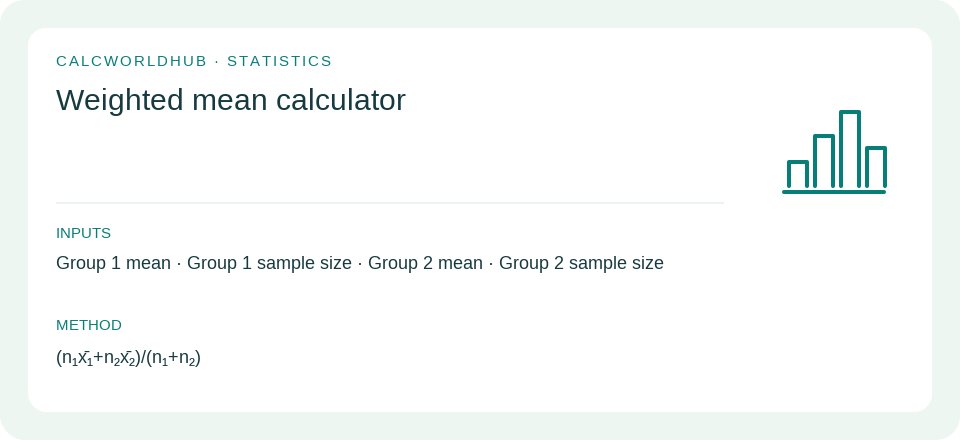
(n₁x̄₁+n₂x̄₂)/(n₁+n₂)
Worked example
(25×12+40×15)/(25+40)=900/65≈13.8462.
Interpreting the result
The combined mean lies between the two group means when both counts are positive. It is not the unweighted average of 12 and 15 because the group sizes differ.
Assumptions and limits
Both means must use the same variable and units. Counts must represent the observations contributing to each mean and must not overlap unless the groups are intended to overlap.
Frequently asked questions
When is the simple average wrong?
When group sizes differ, averaging the two means equally gives each group the same weight.
Can the group means use different units?
No. Convert them to one common scale before combining.
How do I use the Weighted mean calculator?
Enter Group 1 mean, Group 1 sample size, Group 2 mean, Group 2 sample size. Match the units shown beside each field and review the result together with the assumptions below.
What is a worked example of Weighted mean?
(25×12+40×15)/(25+40)=900/65≈13.8462.
What does the Weighted mean calculator calculate?
Combine two group means using their sample sizes so larger groups contribute proportionally more.
See the calculation methodology.
Good calculators show their work.
CalcWorldHub is built around clear inputs and visible assumptions. Results are estimates for planning; check official sources or your provider’s terms when exact figures matter.