How to use this calculator
Calculate the WGS84 ellipsoid’s local radius of curvature for a specified normal-section azimuth.
- Enter Geodetic latitude, degrees, Normal-section azimuth from north, degrees. Match the units shown beside each field and review the result together with the assumptions below.
- Read the worked example below to check the expected input format and result.
- Compare another scenario by changing one input at a time. Use Reset to return to the starting values.
How this calculation works
An ellipsoid has different principal radii of curvature in the meridional and prime-vertical directions. Euler’s curvature formula combines them to give the radius for a normal section at any azimuth, measured clockwise from north in the tangent plane.
Inputs and units
latitude— Geodetic latitude, degrees- North positive; enter a value from −90° to 90°.
azimuth— Normal-section azimuth from north, degrees- Clockwise from north, from 0° to 180°.
Formula
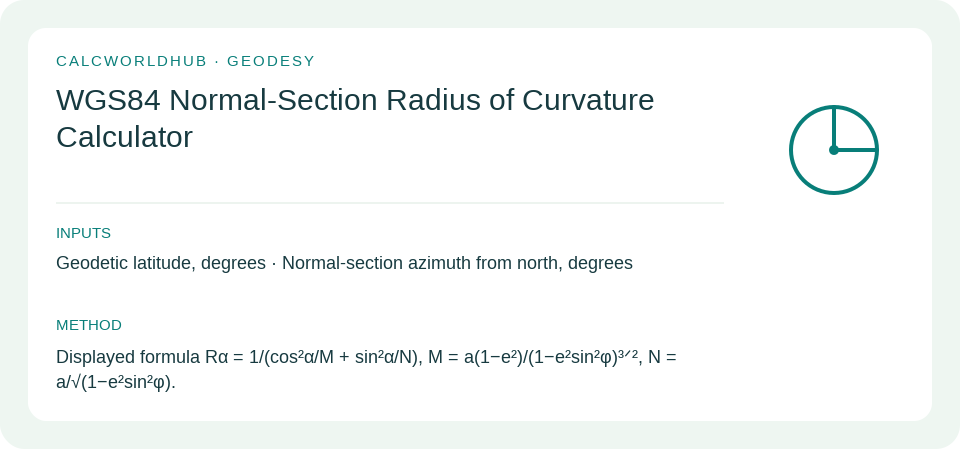
Rα = 1/(cos²α/M + sin²α/N), M = a(1−e²)/(1−e²sin²φ)³ᐟ², N = a/√(1−e²sin²φ).
Method
Compute the WGS84 meridional radius M and prime-vertical radius N at the entered geodetic latitude. Apply Euler’s formula using the azimuth of the requested normal section.
Worked example
At geodetic latitude 45° N and azimuth 30° clockwise from north on WGS84, M ≈ 6,367.382 km, N ≈ 6,388.838 km, and the normal-section radius is about 6,372.732 km.
Assumptions and limits
Uses the WGS84 reference ellipsoid and geodetic latitude. Azimuth is measured clockwise from north; a normal section is a plane through the ellipsoid normal. This is a local curvature radius, not the distance along a geodesic between two points.
Frequently asked questions
What does the azimuth mean here?
It is the clockwise angle from the northward meridian plane to the normal section at the point.
How does this relate to the meridional and prime-vertical radii?
At 0° azimuth the result is M; at 90° it is N. Other azimuths use Euler’s curvature formula.
Is this the radius along a shortest route?
No. A normal section lies in a plane through the ellipsoid normal; a geodesic generally is not a normal section.
How do I use the WGS84 Normal-Section Radius of Curvature Calculator?
Enter Geodetic latitude, degrees, Normal-section azimuth from north, degrees. Match the units shown beside each field and review the result together with the assumptions below.
What is a worked example of WGS84 Normal-Section Radius of Curvature?
At geodetic latitude 45° N and azimuth 30° clockwise from north on WGS84, M ≈ 6,367.382 km, N ≈ 6,388.838 km, and the normal-section radius is about 6,372.732 km.
Reference: technical reference. See our calculation methodology.