How to use this calculator
Estimate drive-wheel torque and tire force from engine torque and the selected gear train.
- Enter Engine torque (N·m), Selected gear ratio, Final drive ratio, Drivetrain efficiency (%), then complete the remaining labeled fields. Match the units shown beside each field and review the result together with the assumptions below.
- Read the worked example below to check the expected input format and result.
- Compare another scenario by changing one input at a time. Use Reset to return to the starting values.
Wheel torque from engine torque gear ratios and drivetrain efficiency explained
Wheel torque multiplies engine torque by the selected gear and final-drive ratios, then applies drivetrain efficiency. Dividing by loaded tire radius estimates ideal tractive force; it does not account for tire grip, traction control, or speed-dependent power limits.
Inputs, symbols, and units
torque— Engine torque (N·m)- Torque at the engine for the chosen RPM.
gear— Selected gear ratio- Transmission input speed divided by output speed.
final— Final drive ratio- Differential ratio multiplying transmission output torque.
eff— Drivetrain efficiency (%)- Fraction of ideal torque transmitted to the driven wheels.
radius— Loaded tire radius (m)- Effective rolling radius under load.
Formula and method
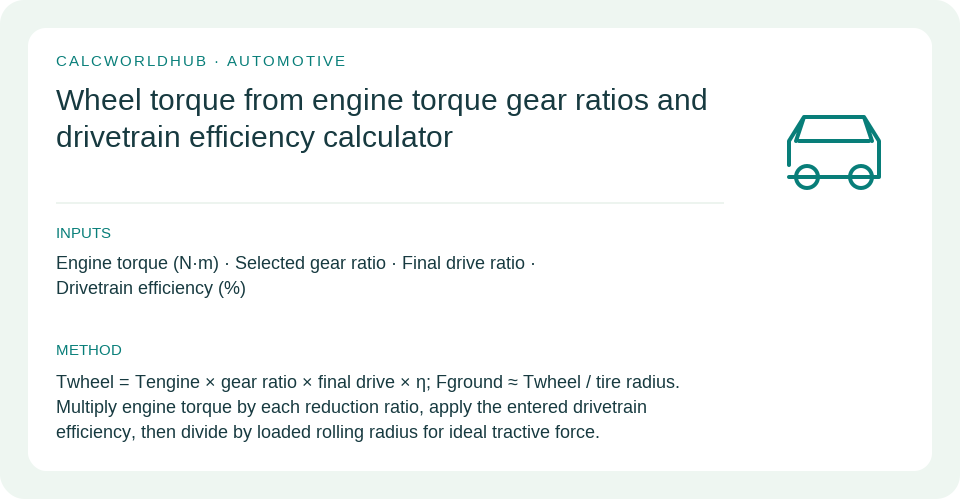
Twheel = Tengine × gear ratio × final drive × η; Fground ≈ Twheel / tire radius.
Multiply engine torque by each reduction ratio, apply the entered drivetrain efficiency, then divide by loaded rolling radius for ideal tractive force.
A worked scenario
Engine torque (N·m) = 250; Selected gear ratio = 3.2; Final drive ratio = 3.9; Drivetrain efficiency (%) = 88; Loaded tire radius (m) = 0.31.
- Estimated wheel torque: 2745.6 N·m
- Ideal tractive force: 8856.774194 N
- Overall ratio: 12.48 :1
At 250 N·m, 3.2:1 gear, 3.9:1 final drive, and 88% efficiency, estimated wheel torque is about 2,746 N·m.
Assumptions and edge cases
No torque-converter multiplication, limited-slip behavior, tire slip, or load transfer is modeled. Ratios must be entered as positive reductions.
Reading the outputs
The main result is estimated wheel torque in N·m; supporting outputs are labeled with their own units. Use the units shown beside each input and result.
Frequently asked questions
What does the wheel torque from engine torque gear ratios and drivetrain efficiency calculate?
At 250 N·m, 3.2:1 gear, 3.9:1 final drive, and 88% efficiency, estimated wheel torque is about 2,746 N·m.
Which inputs most affect estimated wheel torque in n·m?
Multiply engine torque by each reduction ratio, apply the entered drivetrain efficiency, then divide by loaded rolling radius for ideal tractive force.
Can this result replace a site-specific or measured value?
No torque-converter multiplication, limited-slip behavior, tire slip, or load transfer is modeled. Ratios must be entered as positive reductions.
How do I use the Wheel torque from engine torque gear ratios and drivetrain efficiency calculator?
Enter Engine torque (N·m), Selected gear ratio, Final drive ratio, Drivetrain efficiency (%), then complete the remaining labeled fields. Match the units shown beside each field and review the result together with the assumptions below.
What is a worked example of Wheel torque from engine torque gear ratios and drivetrain efficiency?
Engine torque (N·m) = 250; Selected gear ratio = 3.2; Final drive ratio = 3.9; Drivetrain efficiency (%) = 88; Loaded tire radius (m) = 0.31. Estimated wheel torque: 2745.6 N·m Ideal tractive force: 8856.774194 N Overall ratio: 12.48 :1 At 250 N·m, 3.2:1 gear, 3.9:1 final drive, and 88% efficiency, estimated wheel torque is about 2,746 N·m.
Read our calculation methodology.