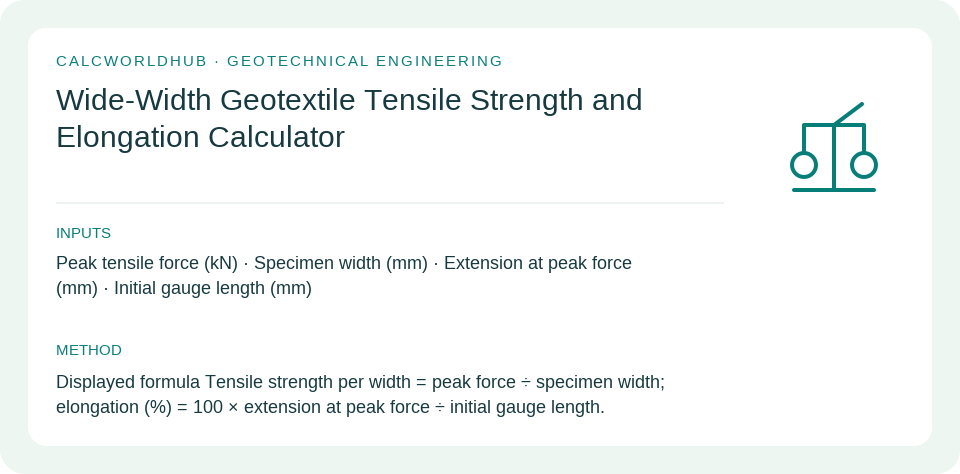
How to use this calculator
Reduce a wide-width geotextile tensile test to tensile force per width and elongation at peak load.
- Enter Peak tensile force (kN), Specimen width (mm), Extension at peak force (mm), Initial gauge length (mm). Match the units shown beside each field and review the result together with the assumptions below.
- Read the worked example below to check the expected input format and result.
- Compare another scenario by changing one input at a time. Use Reset to return to the starting values.
How this calculation works
Enter the peak tensile force, specimen width, extension at peak force, and initial gauge length. The result reports force normalized by specimen width and the gauge-length strain at peak force.
Inputs and units
peakForceKN— Peak tensile force (kN)- Maximum force recorded during the wide-width test.
specimenWidthMm— Specimen width (mm)- Measured width used to normalize tensile force.
extensionAtPeakMm— Extension at peak force (mm)- Extension measured at the same peak-force point.
gaugeLengthMm— Initial gauge length (mm)- Initial distance between gauge marks.
Formula
Tensile strength per width = peak force ÷ specimen width; elongation (%) = 100 × extension at peak force ÷ initial gauge length.
Method
Convert peak force from kilonewtons and width from millimetres to kilonewtons per metre. Divide extension by the initial gauge length and multiply by 100 for elongation.
Worked example
A 10 kN peak force on a 200 mm specimen gives 50 kN/m; 25 mm extension over a 100 mm gauge length is 25% elongation.
Assumptions and limits
This calculator reduces recorded test measurements; it does not implement specimen conditioning, clamping, strain-rate control, wet/dry conditioning, or laboratory acceptance rules. Confirm that force and extension are taken at the same defined point on the test curve.
Frequently asked questions
Why normalize force by width?
Force per unit specimen width lets wide-width tensile results be compared on a consistent basis.
What does elongation describe here?
It is the gauge-length extension divided by the original gauge length at the selected peak-force point.
Does this replace the standard test?
No. The standard controls conditioning, specimen handling, clamping, and test procedure.
How do I use the Wide-Width Geotextile Tensile Strength and Elongation Calculator?
Enter Peak tensile force (kN), Specimen width (mm), Extension at peak force (mm), Initial gauge length (mm). Match the units shown beside each field and review the result together with the assumptions below.
What is a worked example of Wide-Width Geotextile Tensile Strength and Elongation?
A 10 kN peak force on a 200 mm specimen gives 50 kN/m; 25 mm extension over a 100 mm gauge length is 25% elongation.
Reference: ASTM D4595/D4595M-24 wide-width geotextile tensile test method. See our calculation methodology.