How to use this calculator
Calculate soil unconfined compressive strength from a selected test load, specimen dimensions, and axial deformation.
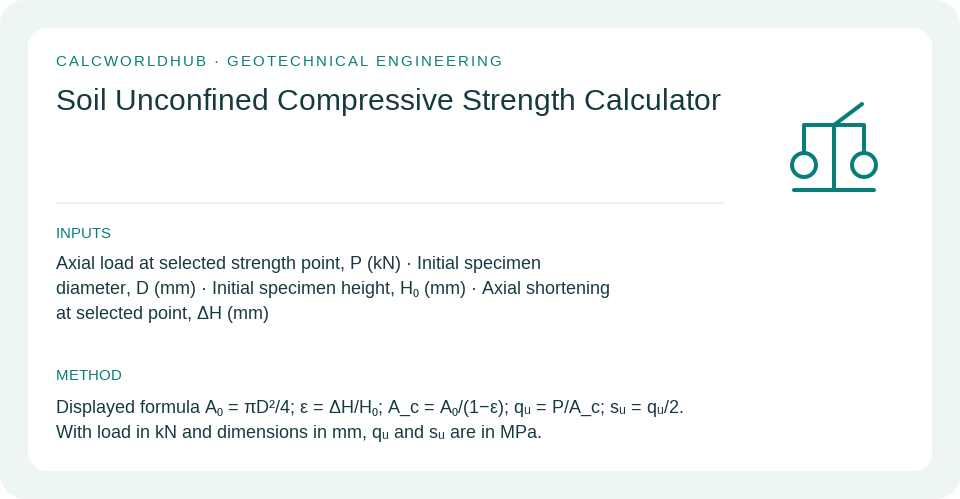
- Enter Axial load at selected strength point, P (kN), Initial specimen diameter, D (mm), Initial specimen height, H₀ (mm), Axial shortening at selected point, ΔH (mm). Match the units shown beside each field and review the result together with the assumptions below.
- Read the worked example below to check the expected input format and result.
- Compare another scenario by changing one input at a time. Use Reset to return to the starting values.
How this calculation works
Enter the axial load and specimen shortening at the reported strength point, together with the specimen’s initial diameter and height. Use the peak-load point, or the 15% axial-strain point when no peak occurs by then.
Inputs and units
peakLoadKn— Axial load at selected strength point, P (kN)- Measured compression load at the peak, or at 15% axial strain if the load has not peaked.
diameterMm— Initial specimen diameter, D (mm)- Initial diameter of the cylindrical soil specimen.
initialHeightMm— Initial specimen height, H₀ (mm)- Specimen height before axial loading.
shorteningMm— Axial shortening at selected point, ΔH (mm)- Positive reduction in specimen height at the selected strength reading. The entered point must be at or before 15% axial strain.
Formula
A₀ = πD²/4; ε = ΔH/H₀; A_c = A₀/(1−ε); qᵤ = P/A_c; sᵤ = qᵤ/2. With load in kN and dimensions in mm, qᵤ and sᵤ are in MPa.
Method
Calculate the initial circular area and axial strain from the specimen shortening. Correct the area using A_c = A₀/(1−ε), then divide the measured axial load by that corrected area. The displayed undrained shear strength is half of qᵤ under the conventional φᵤ = 0 interpretation.
Worked example
For a 12.00 kN load, 38 mm initial diameter, 76 mm initial height, and 4 mm shortening, the axial strain is 5.263%. The corrected area is 1,197.12 mm², giving qᵤ = 10.0240 MPa and sᵤ = 5.0120 MPa.
Assumptions and limits
Use a cohesive soil specimen tested without lateral confinement. Enter the peak compressive-load reading, or the reading at 15% axial strain if the load has not peaked by then. The area correction assumes the standard constant-volume geometry approximation. sᵤ = qᵤ/2 is an undrained total-stress interpretation, not an allowable bearing pressure or a substitute for project-specific design parameters.
Frequently asked questions
Why is the specimen area corrected?
Axial compression shortens the specimen, so the conventional unconfined-compression calculation increases its cross-sectional area as A₀/(1−ε) before computing stress.
Which load should I enter?
Use the maximum compressive load if a peak occurs. If the load does not peak by 15% axial strain, use the load measured at 15% strain.
When is sᵤ = qᵤ/2 appropriate?
It is the conventional undrained total-stress interpretation for cohesive soil with φᵤ taken as zero. Do not use it as a design allowable pressure without a project-specific geotechnical assessment.
How do I use the Soil Unconfined Compressive Strength Calculator?
Enter Axial load at selected strength point, P (kN), Initial specimen diameter, D (mm), Initial specimen height, H₀ (mm), Axial shortening at selected point, ΔH (mm). Match the units shown beside each field and review the result together with the assumptions below.
What is a worked example of Soil Unconfined Compressive Strength?
For a 12.00 kN load, 38 mm initial diameter, 76 mm initial height, and 4 mm shortening, the axial strain is 5.263%. The corrected area is 1,197.12 mm², giving qᵤ = 10.0240 MPa and sᵤ = 5.0120 MPa.
Reference: technical reference. See our calculation methodology.