How to use this calculator
Estimate undrained shear strength from corrected peak torque and a rectangular vane’s diameter and height.
- Enter Corrected peak torque T (N·m), Vane diameter D (mm), Vane height H (mm). Match the units shown beside each field and review the result together with the assumptions below.
- Read the worked example below to check the expected input format and result.
- Compare another scenario by changing one input at a time. Use Reset to return to the starting values.
How this calculation works
A field vane test infers the undrained shear strength of soft cohesive soil from the torque needed to rotate a four-blade vane to failure. This calculator uses the conventional resistance model for the cylindrical side surface plus the two circular ends. Enter the peak torque after removing the torque attributable to the rod and apparatus, along with the vane diameter and height.
Inputs and units
peakTorque— Corrected peak torque T (N·m)- Use peak torque after subtracting rod and apparatus friction.
diameter— Vane diameter D (mm)- Enter the vane blade diameter, not the borehole diameter.
height— Vane height H (mm)- Enter the height of the rectangular vane blades.
Formula
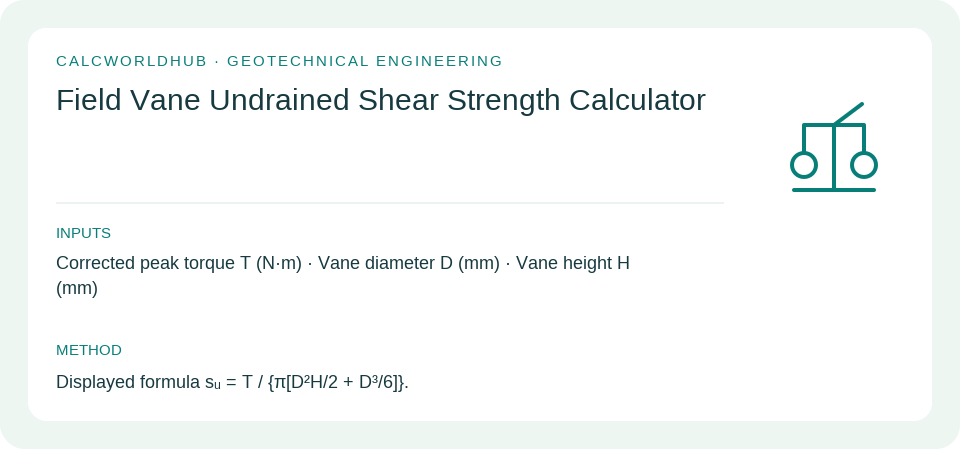
sᵤ = T / {π[D²H/2 + D³/6]}.
Method
Convert the entered vane dimensions from millimetres to metres. The denominator is the resisting moment factor for a cylindrical failure surface and the two circular end surfaces. Divide corrected peak torque by that factor to obtain pascals, then convert to kilopascals.
Worked example
With corrected peak torque 12 N·m, vane diameter 65 mm, and height 130 mm, the conventional model gives undrained shear strength about 11.92 kPa.
Assumptions and limits
Assumes uniform undrained shear strength along the cylindrical side and both circular ends of a rectangular four-blade vane. Use the method only for compatible vane geometry and test conditions; subtract rod and apparatus friction from measured torque first. It does not apply a disturbance correction or determine remoulded strength and sensitivity.
Frequently asked questions
Should I enter the raw measured torque?
Enter peak torque after subtracting torque caused by the rod and testing apparatus, using the correction required by the applicable field method.
Does the calculator estimate remoulded strength?
No. It estimates peak undrained strength only. A remoulded test and the applicable field procedure are needed for sensitivity.
What vane dimensions does the equation use?
Use the blade diameter and blade height. The entered millimetres are converted to metres before torque is divided by the vane resistance factor.
How do I use the Field Vane Undrained Shear Strength Calculator?
Enter Corrected peak torque T (N·m), Vane diameter D (mm), Vane height H (mm). Match the units shown beside each field and review the result together with the assumptions below.
What is a worked example of Field Vane Undrained Shear Strength?
With corrected peak torque 12 N·m, vane diameter 65 mm, and height 130 mm, the conventional model gives undrained shear strength about 11.92 kPa.
Reference: FHWA Geotechnical Engineer Circular #5 field-vane torque and geometry guidance. See our calculation methodology.