How to use this calculator
Calculate the normalized CPT soil-behavior index and its two input coordinates while avoiding an automatic lithology label.
- Enter Corrected cone resistance qt (MPa), Sleeve friction fs (kPa), Total vertical stress (kPa), Effective vertical stress (kPa). Match the units shown beside each field and review the result together with the assumptions below.
- Read the worked example below to check the expected input format and result.
- Compare another scenario by changing one input at a time. Use Reset to return to the starting values.
CPT normalized soil behavior index explained
The classic CPT soil-behavior index combines normalized net cone resistance with normalized sleeve friction on logarithmic axes. Convert corrected tip resistance to the same stress unit before subtracting total overburden; this form uses full effective-stress normalization rather than iterative Qtn.
Inputs, symbols, and units
qc— Corrected cone resistance qt (MPa)- Corrected tip resistance qt after the applicable pore-pressure area correction; raw qc is not corrected by this tool.
fs— Sleeve friction fs (kPa)- Measured sleeve friction in kPa.
sv— Total vertical stress (kPa)- Total overburden stress to subtract from cone resistance.
se— Effective vertical stress (kPa)- Positive effective overburden used to normalize net tip resistance.
Formula and method
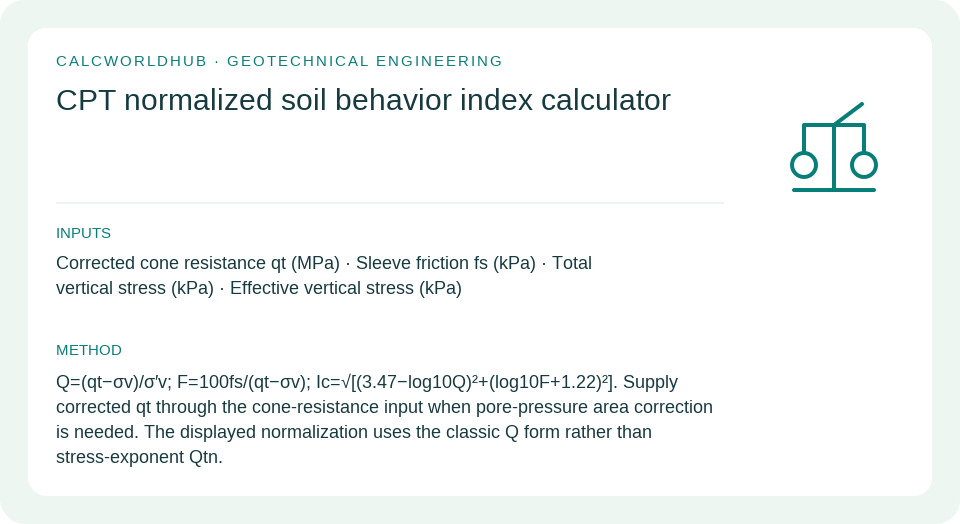
Q=(qt−σv)/σ′v; F=100fs/(qt−σv); Ic=√[(3.47−log10Q)²+(log10F+1.22)²].
Supply corrected qt through the cone-resistance input when pore-pressure area correction is needed. The displayed normalization uses the classic Q form rather than stress-exponent Qtn.
A worked scenario
Corrected cone resistance qt (MPa) = 5; Sleeve friction fs (kPa) = 50; Total vertical stress (kPa) = 150; Effective vertical stress (kPa) = 90.
- Soil behavior index Ic: 2.131487
- Normalized cone resistance Q: 53.888889
- Friction ratio F: 1.030928 %
A corrected cone resistance of 5 MPa and sleeve friction 50 kPa at 150 kPa total and 90 kPa effective stress give net cone resistance 4850 kPa.
Assumptions and edge cases
Positive net resistance and friction only. Ic is a behavior index, not a direct soil identification, and no pore-pressure correction, Qtn iteration or liquefaction estimate is included. Educational model; this is not a code-compliant design check.
Reading the outputs
Ic and Q are dimensionless; F is sleeve friction as a percentage of net cone resistance.
Frequently asked questions
Why enter MPa for qt but kPa for fs?
These are common reporting units; qc is multiplied by 1000 internally before stress subtraction.
Does a particular Ic prove a soil is clay?
No. Soil behavior can differ from grain-based classification; sampling and local interpretation remain important.
Is this the iterative Qtn method?
No. The page explicitly uses Q normalized by the full effective overburden stress.
How do I use the CPT normalized soil behavior index calculator?
Enter Corrected cone resistance qt (MPa), Sleeve friction fs (kPa), Total vertical stress (kPa), Effective vertical stress (kPa). Match the units shown beside each field and review the result together with the assumptions below.
What is a worked example of CPT normalized soil behavior index?
Corrected cone resistance qt (MPa) = 5; Sleeve friction fs (kPa) = 50; Total vertical stress (kPa) = 150; Effective vertical stress (kPa) = 90. Soil behavior index Ic: 2.131487 Normalized cone resistance Q: 53.888889 Friction ratio F: 1.030928 % A corrected cone resistance of 5 MPa and sleeve friction 50 kPa at 150 kPa total and 90 kPa effective stress give net cone resistance 4850 kPa.
Background or definition reference: FHWA Soils and Foundations Reference Manual, Volume I.
Read our calculation methodology.