How to use this calculator
Estimate instantaneous wind-turbine output from rotor size, wind speed, air density, and conversion efficiencies.
- Enter Rotor diameter (m), Wind speed (m/s), Air density (kg/m³), Power coefficient Cp (0–0.593), then complete the remaining labeled fields. Match the units shown beside each field and review the result together with the assumptions below.
- Read the worked example below to check the expected input format and result.
- Compare another scenario by changing one input at a time. Use Reset to return to the starting values.
How this calculation works
The power in moving air grows with swept rotor area and the cube of wind speed. This estimate applies a user-entered power coefficient and generator efficiency to that wind power; it is a simplified operating-point calculation, not a prediction of annual production.
Inputs and units
diameterM— Rotor diameter (m)- Diameter across the swept rotor area, not blade length.
windSpeed— Wind speed (m/s)- Use wind speed at the turbine rotor and the operating point being estimated.
airDensity— Air density (kg/m³)- A common near-sea-level reference; actual density depends on temperature, pressure, and humidity.
powerCoefficient— Power coefficient Cp (0–0.593)- Fraction of wind power extracted by the rotor in this simplified model.
efficiency— Generator and drivetrain efficiency (%)- Enter combined downstream efficiency as a percentage.
Formula
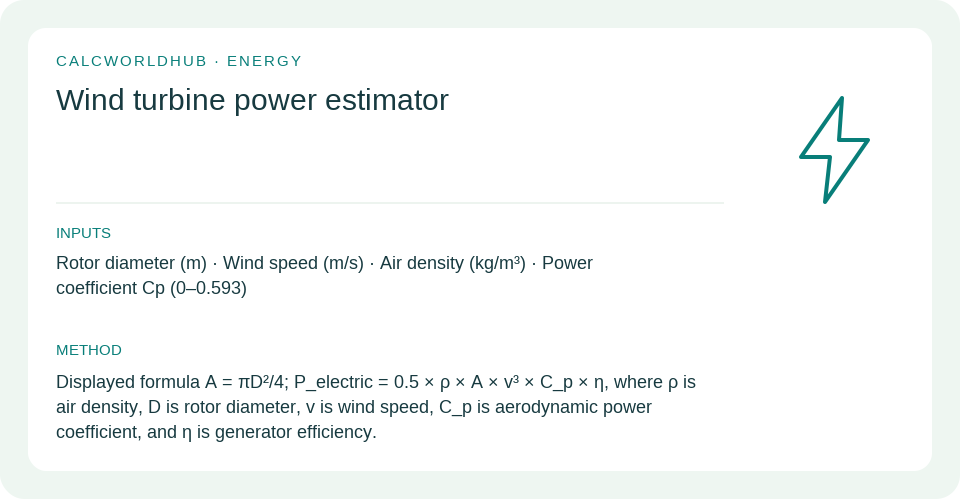
A = πD²/4; P_electric = 0.5 × ρ × A × v³ × C_p × η, where ρ is air density, D is rotor diameter, v is wind speed, C_p is aerodynamic power coefficient, and η is generator efficiency.
Method
Enter rotor diameter in metres, wind speed in metres per second, air density in kilograms per cubic metre, and fractions for power coefficient and efficiency. The result is an idealized electrical power at that wind speed.
Worked example
With a 4 m rotor, 8 m/s wind, density 1.225 kg/m³, Cp = 0.35, and 90% efficiency, the estimate is about 1.24 kW at that operating point.
Assumptions and limits
Real turbines have power curves, cut-in and cut-out limits, rated-power caps, turbulence, electrical losses, and site effects. The coefficient cannot exceed the Betz theoretical limit of 0.593; use manufacturer data for design or energy-yield estimates.
Frequently asked questions
Why does wind speed have such a large effect?
The available kinetic power in wind is proportional to the cube of speed, so small speed changes can strongly change the idealized estimate.
Is this the turbine's rated output?
No. Rated output depends on the manufacturer's power curve and control limits; this formula is a simplified operating-point estimate.
Can this estimate annual energy?
Not by itself. Annual yield requires a site wind-speed distribution, turbine power curve, availability, and losses.
How do I use the Wind turbine power estimator?
Enter Rotor diameter (m), Wind speed (m/s), Air density (kg/m³), Power coefficient Cp (0–0.593), then complete the remaining labeled fields. Match the units shown beside each field and review the result together with the assumptions below.
What is a worked example of Wind turbine power estimator?
With a 4 m rotor, 8 m/s wind, density 1.225 kg/m³, Cp = 0.35, and 90% efficiency, the estimate is about 1.24 kW at that operating point.
Reference: U.S. Department of Energy small-wind guidebook. See our calculation methodology.